


WhatsApp:
+86-18123969340
+86-13691824013

Views: 0 Author: Site Editor Publish Time: 2026-11-16 Origin: Site


Metal parts often emerge from the wash process looking completely pristine. However, they soon dry with distinct white spotting. This frustrating phenomenon leads to immediate QA rejections on the factory floor. Surface contamination compromises critical downstream processes like plating, coating, and welding. It also drives up rework costs and heavily disrupts production schedules. You might assume a hotter wash or a longer cycle will fix the issue. Yet, these spots are rarely a localized anomaly. They usually indicate a systemic mismatch between water quality, drying mechanics, and your selected chemistry. Resolving it requires evaluating your total cleaning envelope. You cannot just increase wash temperatures and hope for the best. In this guide, we will explore the exact root causes behind these blemishes. You will learn how to diagnose the issue effectively. We will also show you how to upgrade your mechanical processes to achieve consistently spotless parts.
Diagnosing white spots on metal after cleaning starts by identifying the exact nature of the residue. You must understand what is actually left on the surface. Several entirely different culprits can create very similar visual defects.
Facility tap water usually contains Total Dissolved Solids (TDS). These solids primarily consist of calcium, magnesium, and silicates. When untreated facility water evaporates on a warm metal part, the moisture disappears into the air. The dissolved minerals remain behind on the substrate. These spots generally appear chalky and white. You can usually wipe them away easily using a mild acidic solution.
Many facilities rely on high-solid, low-rinsability cleaners. These chemicals easily "drag out" from the wash bath into the subsequent rinse stages. If the rinse stage lacks sufficient overflow, detergent quickly builds up. This soapy film bakes onto the part during the thermal drying cycle. Detergent spots often exhibit a slight iridescent sheen. They may also feel slick or soapy when you re-wet them.
Sometimes your chemistry and water quality are perfectly fine. The problem lies entirely in how you dry the parts. Allowing water to pool in crevices is a major engineering mistake. If water evaporates naturally rather than being physically displaced, spots will form. Even trace contaminants concentrate heavily as the water droplet shrinks.
Inspectors often mistake early-stage oxidation for mineral deposits. Sensitive alloys like cast iron or certain aluminums react quickly to ambient moisture. This early micro-corrosion can manifest as white or light-grey speckling. Over time, these spots will eventually turn brown or black. You must identify this quickly to adjust your rust inhibitor protocols.
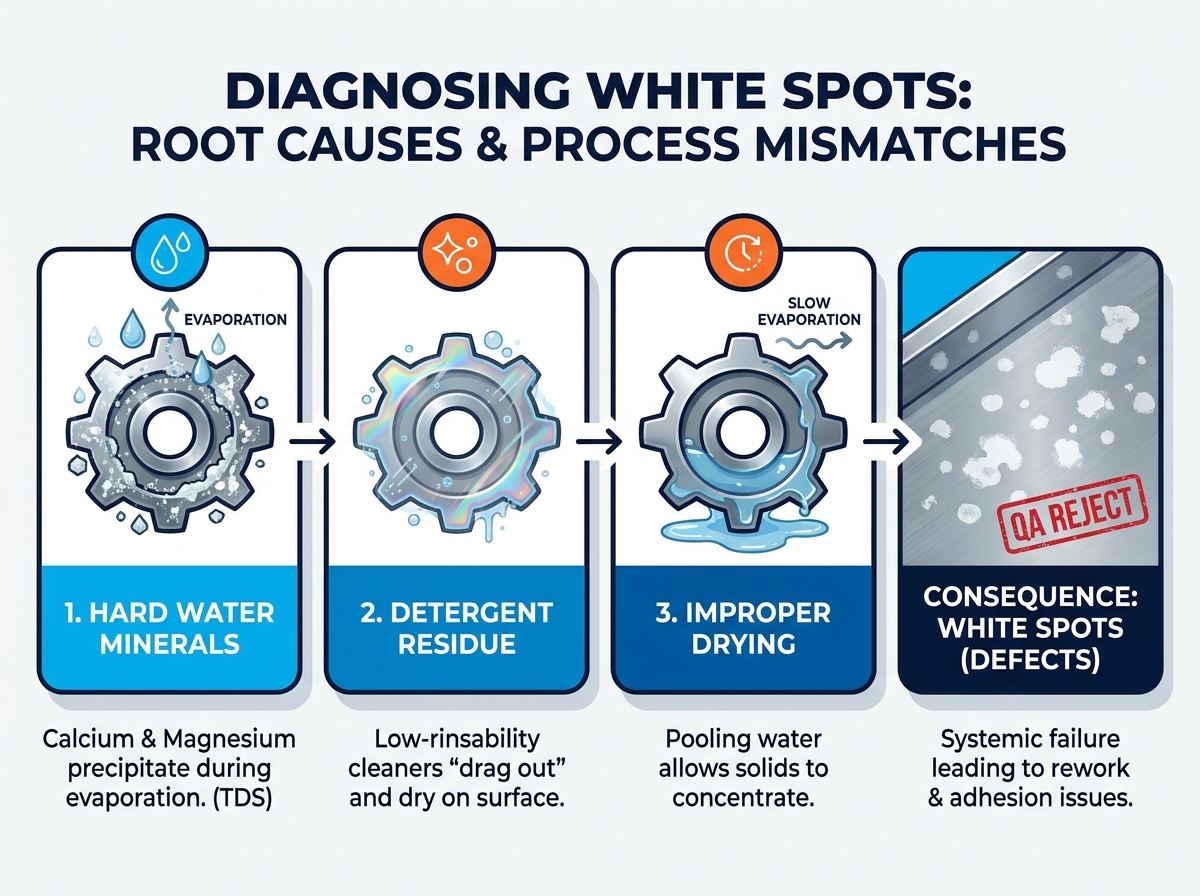
Accepting marginal cleaning results is a costly manufacturing mistake. White spots are not just a minor aesthetic issue. They represent active chemical contamination threatening your entire production run.
Microscopic residues beneath those white spots actively repel industrial coatings. They cause severe delamination in powder coating and electroplating applications. Vacuum metallizing processes will also fail catastrophically. The coating grabs onto the chalky residue instead of the base metal. When the residue flakes off, the expensive coating goes right along with it.
Visible spotting inevitably triggers massive quality assurance bottlenecks. Your team faces hidden labor costs from manual wiping and inspection. Workers must re-run failed components through multiple wash cycles. This completely disrupts your careful production pacing. Every minute spent reworking a rejected part destroys your operational margins.
Procurement teams often try saving money on commodity degreasers. This strategy ultimately inflates your long-term operational costs. Cheap chemistry usually lacks proper rinsing agents. You end up using excessive water to compensate for poor rinsability. The resulting higher scrap rates completely erase any initial chemical savings. Quality chemistry pays for itself by keeping the production line moving smoothly.
Selecting the right water-based industrial cleaner requires looking beyond raw degreasing power. You need a formula engineered specifically for clean rinsing and spotless drying.
Traditional soaps leave heavy films behind on metal surfaces. Modern formulations use low-foaming, high-rinsability surfactants instead. These advanced molecules break the water's surface tension rapidly. This action prevents chemical drag-out into your rinse tanks. The wash solution sheets off the metal rather than clinging stubbornly to it.
Hard water is a constant threat to part cleanliness. High-quality cleaners include robust chelating agents in their formula. These chelatants actively bind to hard water ions like calcium and magnesium. They suspend the minerals in the wash solution safely. This allows them to rinse away smoothly rather than precipitating onto the metal.
You must always match the cleaner’s pH to your specific substrate. Highly alkaline cleaners easily cause white etching on aluminum and zinc. This etching looks exactly like a hard water spot. However, it is actually physical damage to the metal surface. Evaluating and testing buffered chemistries is critical for sensitive alloys.
Some industries cannot tolerate even a microscopic speck of residue. High-vacuum or medical-grade precision applications demand absolute cleanliness. Look for chemistries explicitly engineered for these strict environments. Zero-residue performance must be a baseline compliance requirement, not an optional upgrade.
Upgrading your detergents is only the first step. Even a premium precision parts cleaning agent is not a silver bullet. If your mechanical process is fundamentally broken, spots will still appear.
You cannot solve poor equipment design with better soap. Dead zones in your wash tank will leave soils behind. Clogged rinse nozzles will fail to remove detergent films. You must maintain your physical equipment to let the chemistry work properly.
Upgrading your final rinse water is often mandatory for spotless results. Reverse Osmosis (RO) or Deionized (DI) water removes the dissolved solids entirely. If your local water is exceptionally hard, tap water will always leave spots. Using RO or DI water in the final stage guarantees a clean evaporation.
| Water Quality Level | Mineral Content (TDS) | Spotting Risk | Best Application |
|---|---|---|---|
| Standard Tap Water | High (100 - 400+ ppm) | Severe | Initial gross wash stages, non-critical parts |
| Reverse Osmosis (RO) | Low (10 - 30 ppm) | Minimal | General final rinse, pre-plating preparation |
| Deionized (DI) | Zero (0 ppm) | None | Medical devices, high-vacuum components, optics |
You must remove water quickly before it has time to evaporate. Implementing high-velocity air knives is a highly effective strategy. These knives physically shear the water off the parts mechanically. For complex geometries with blind holes, standard air drying fails. You should evaluate vacuum drying systems to boil moisture out of hidden crevices.
An overloaded wash bath simply acts as a new contaminant source. You must establish strict titration schedules for your cleaning tanks. Regular testing prevents massive soil redeposition on your parts. Dump and recharge your baths before they reach their maximum soil load.
Guesswork has no place in modern industrial cleaning. You need a structured framework to validate your new chemistry and processes.
You cannot improve what you cannot measure objectively. Establish measurable cleanliness standards before you start testing new cleaners.
Always filter out chemistries violating your local environmental regulations. Reject formulas containing PFAS or harsh restricted solvents. You must also consider how the cleaner impacts your wastewater treatment facility. A great cleaner is useless if it shuts down your effluent plant.
Do not rely on marketing brochures when evaluating chemical vendors. Demand comprehensive Technical Data Sheets (TDS) and Safety Data Sheets (SDS). Focus specifically on the rinsing profiles detailed in the documentation. Always verify their official substrate compatibility lists before testing on expensive parts.
Never switch your chemistry facility-wide based on a single lab sample. What works in a beaker often fails in a massive spray cabinet. Require a limited batch run in your actual production equipment. This is the only way to validate true drying performance and spot prevention.
White spots on metal parts are a completely solvable engineering problem. They are never an inevitable byproduct of aqueous cleaning. You simply need to address the variables causing the contamination.
The right decision involves aligning three critical production pillars. You must deploy a highly rinsable cleaner tailored to your substrate. You must control your rinse water quality to eliminate dissolved solids. Finally, you must implement effective drying mechanics to shear moisture away quickly.
It is time to audit your current wash, rinse, and dry line. Consult with a chemical formulation engineer to identify your specific bottlenecks. Initiate controlled pilot testing to prove out your new process. By taking these methodical steps, you will eliminate white spots and drastically reduce rework.
A: Often, stronger or more concentrated cleaners actually make spotting worse. They increase the solid chemical residue load in your bath. If your rinsing mechanics are weak, this extra chemistry remains on the part. High rinsability and rapid surface tension reduction are the true solutions, not raw chemical strength.
A: It depends heavily on your local water hardness and your exact cleanliness specification. For aesthetic parts or pre-plating applications, RO or DI water is usually mandatory. For intermediate rust-prevention washes, standard tap water paired with a high-quality chelating cleaner may suffice.
A: Aluminum is a highly reactive metal compared to steel. The white spots you see may actually be localized micro-etching. This happens when a cleaner's pH is too high for the soft alloy. It is physical damage to the substrate, rather than mineral deposits sitting on top of it.


