


WhatsApp:
+86-18123969340
+86-13691824013

Views: 0 Author: Site Editor Publish Time: 2026-10-30 Origin: Site


Replacing a cleaning bath too early wastes valuable chemistry, water, and labor. However, waiting too long risks catastrophic part rejection and extensive downstream process failures. Facility managers face this core production dilemma every single day. Visual inspection alone remains an unreliable metric for modern manufacturing environments. Operators cannot just look at a dark tank and guess its cleaning efficacy. Objective data proves strictly necessary to balance high operational efficiency alongside rigorous quality standards.
This checklist provides a reliable framework to solve these daily challenges. We help you transition from subjective guesswork to a strictly data-driven bath replacement protocol. You will learn exactly how to monitor soil loads, test chemical viability, and schedule changeouts properly. Implementing these steps ensures consistent part quality across shifts while carefully optimizing your chemical spend and maintaining strict environmental compliance.
Objective Metrics Over Visuals: Rely on titration, pH levels, and conductivity rather than bath color or operator intuition.
Contamination Thresholds: Establish hard limits for total suspended solids (TSS) and tramp oils before they cause soil redeposition.
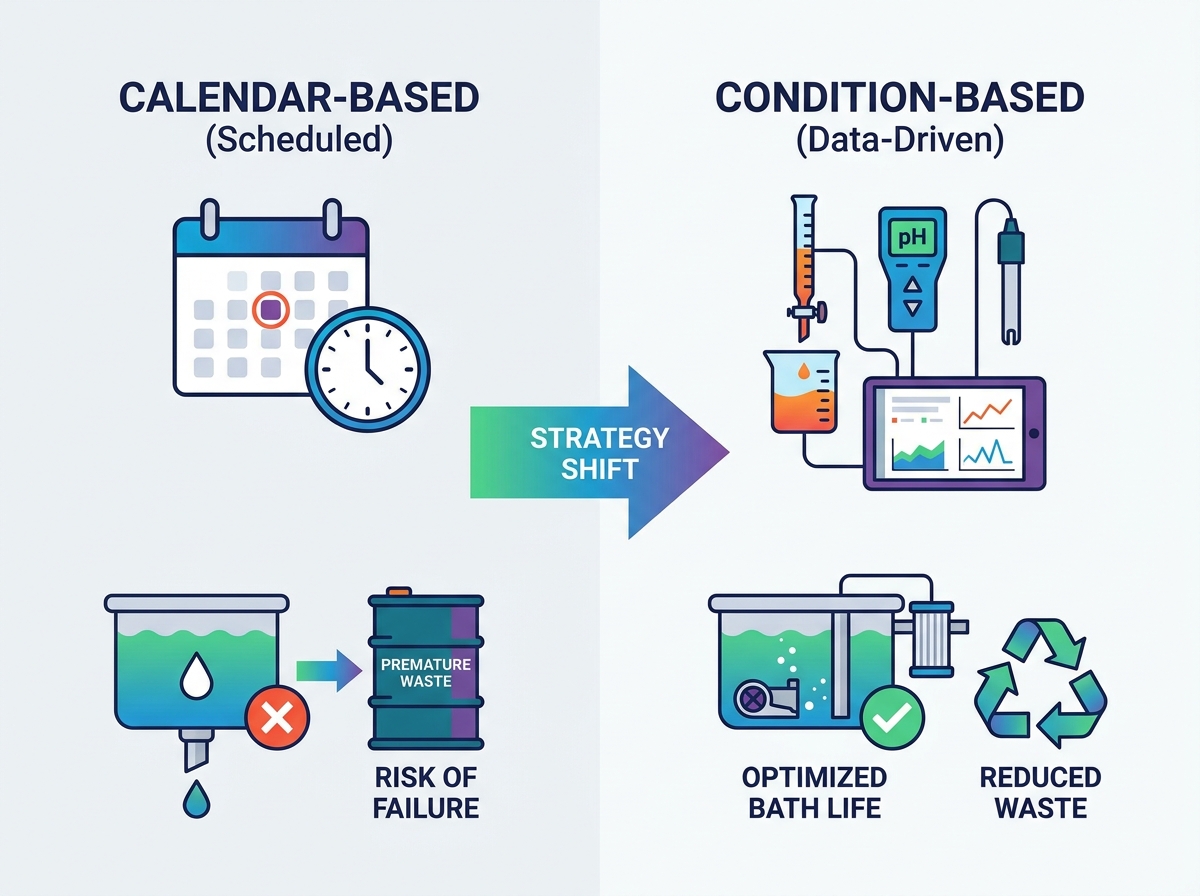
Strategy Shift: Moving from calendar-based dumping to condition-based replacement extends bath life and reduces chemical waste.
Compliance Integration: Standardizing replacement cycles must align with local wastewater treatment and disposal regulations.
Manufacturers routinely underestimate the true expenses of an exhausted cleaning bath. You might only look at the raw price of fresh chemicals in a drum. However, you must calculate the compounded expenses of poor quality. Reworking dirty parts drains labor resources quickly. It ties up valuable floor space and bottlenecks production. Delayed shipments frustrate major clients and damage your market reputation. Running an exhausted tank also wastes tremendous thermal energy. Sludge insulates the heating elements. The heater runs continuously, yet the parts emerge contaminated. Every minute spent re-cleaning parts destroys your daily production schedule.
Many facility managers fall into the "safety margin" trap. They dump baths prematurely just to feel safe. They prefer wasting chemicals over failing a strict quality audit. This emotional approach artificially inflates your expenditure per cleaned part. We often see plants dumping perfectly viable solutions every single Friday afternoon. Operators wrongly assume the bath will fail by Monday morning. This deeply ingrained habit destroys operational efficiency.
A successful bath management protocol defines strict success criteria. It completely eliminates guesswork from the factory floor. You should aim for three primary objectives:
Achieve zero quality rejects caused by improper washing.
Minimize unwanted downtime for unexpected bath changeouts.
Maximize the operational life of the active chemistry.
You achieve these specific goals by tracking real operational data. Your team must stop relying on visual cues. They must embrace objective testing tools to monitor bath health accurately.
Operators must monitor chemical concentration relentlessly. We recommend performing daily or shift-based titrations. This practice ensures your water-based industrial cleaners remain strictly within the manufacturer’s specified operational window. Relying on guesswork inevitably leads to dangerous chemical imbalances. Titration provides an exact mathematical value representing your active alkalinity. It tells you exactly how much cleaner remains available to attack new soils.
You face a significant risk if you just add raw chemistry to a heavily contaminated bath. Operators commonly call this practice "chasing concentration." You pour in fresh chemicals to fix a low titration score. You ignore the massive soil load floating in the tank. The fresh surfactants cannot function correctly. They get smothered by excessive tramp oils immediately. This practice wastes your new chemical additions completely. You end up with a highly concentrated, yet entirely ineffective, sludge.
Pay close attention to rapid pH and conductivity shifts. A sudden drop in pH often signals imminent danger. It indicates the alkaline buffering agents are completely depleted. Once these chemical buffers fail, the bath loses its cleaning power rapidly. The solution can no longer neutralize acidic soils introduced by the parts. Conductivity serves as a vital supplementary metric here. It helps you identify the steady buildup of dissolved inorganic soils. As these dissolved soils accumulate, bath conductivity rises predictably. A severe conductivity spike means you need a fresh bath.
Establish clear contamination and soil load limits today. You need strict frameworks for measuring total suspended solids (TSS) and tramp oil saturation. TSS includes metal shavings, abrasive dust, and ambient factory dirt. Tramp oils include hydraulic fluids and stamping lubricants dragged in on the parts. Mechanical filtration and oil skimmers work very well initially. They remove gross soils from the surface and fluid body effectively. However, they eventually reach a severe point of diminishing returns. The daily drag-in rate of new soils simply outpaces the removal equipment. When TSS exceeds acceptable limits, you must dump the bath.
Table 1: Objective Metrics Monitoring Framework
| Metric Category | Testing Frequency | Failure Indicator | Recommended Action |
|---|---|---|---|
| Titration (Alkalinity) | Once per shift | Drops below manufacturer minimum | Add fresh chemical; check soil load first |
| Bath pH Level | Daily | Sudden drop of 1.0 or more | Evaluate buffer depletion; prepare to dump |
| Conductivity | Weekly | Sharp upward spike | Dump bath due to high dissolved inorganics |
| Total Suspended Solids | Weekly | Filters clog immediately after changing | Dump bath; clean sludge from tank bottom |
You must watch carefully for surface residue and redeposition. These act as glaring warning signs of chemical exhaustion. The bath might remove soils from one part successfully initially. However, it then redeposits those exact same soils onto another part. This creates a thin, stubborn film across the substrate. This cross-contamination ruins entire production runs. You lose days of work to rework queues.
High-performance precision parts cleaning agents rely on highly specific surfactant ratios. These engineered chemical ratios form microscopic micelles around oil molecules. They suspend the dirt in the water column safely away from the parts. However, this delicate mechanism fails completely when overwhelmed by excessive particulate matter. The protective micelles break apart under the heavy soil load. The soils crash back down onto your clean parts. When operators notice a greasy film on exiting parts, the bath is dead.
Downstream processing failures serve as the ultimate indicator of bath failure. Unfortunately, they occur very late in the overall production cycle. Poor paint adhesion, weak structural welds, and electroplating blisters all trace back to improper cleaning. If a painted part peels in the field, look directly at your wash tank logs. The root cause usually involves exhausted chemistry failing to prep the surface properly.
We highly recommend implementing intermediary tests immediately after the wash stage. You must catch failures before parts move to expensive finishing departments.
Perform tests before parts dry completely: Wet parts reveal surface tension issues easily.
Use dyne pens: Check surface energy levels accurately. A passing dyne level proves oils are gone.
Conduct water break tests: A clean part holds a continuous, unbroken sheet of water. If the water beads up, oils remain on the surface.
These industry-standard rapid tests reveal microscopic surface contaminants instantly. They validate your bath chemistry on the spot. They prevent bad parts from receiving expensive coatings.
Facilities generally choose between two primary solution categories. They use either calendar-based or condition-based replacement strategies. You must evaluate these approaches carefully to optimize your operations.
Calendar-based scheduling relies on predictable, rigid timelines. You dump the tank every Friday or at the end of a specific operating shift.
Pros: It simplifies maintenance scheduling immensely. It makes operator training very easy. Everyone knows exactly when the dump happens. ISO compliance auditors appreciate the predictable paperwork.
Cons: The financial drawbacks are severe. You waste perfectly good chemistry during low-production weeks. Conversely, you risk catastrophic quality failures during unexpectedly high-production weeks. The calendar knows nothing about your actual soil load.
Condition-based scheduling operates entirely on objective data. The pros heavily outweigh the cons for modern manufacturing facilities.
Pros: This method maximizes your chemical return on investment. It extends bath life significantly by preventing premature dumps. It also ensures consistent part quality regardless of production volume fluctuations.
Cons: Implementation requires strict adherence to daily testing protocols. You also need to invest in proper instrumentation, like digital pH meters and titration kits. Training takes slightly longer.
We guide decision-makers through a logical, step-by-step transition process. Do not switch methods overnight. Start by implementing daily condition-based testing alongside your current schedule. Do not change your dumping schedule quite yet. Record the titration and pH data meticulously for thirty days. Establish a firm operational baseline based on real evidence. Identify the exact day the chemistry actually fails. This recorded data can eventually inform a highly accurate calendar schedule. You tailor this new schedule specifically to your facility's true production volume and drag-in rates.
Table 2: Strategy Comparison Chart
| Strategy Type | Primary Trigger | Chemical Waste Risk | Quality Failure Risk |
|---|---|---|---|
| Calendar-Based | Time (e.g., Weekly) | High (Dumping good chemistry) | High (Exhausting bath early) |
| Condition-Based | Data (pH, Titration) | Low (Maximized lifespan) | Low (Caught before failure) |
| Hybrid Approach | Data-Informed Schedule | Moderate | Low |
A technical checklist remains only as good as the operators using it on the floor. You must prioritize comprehensive operator training and strict protocol adherence. These human factors represent your biggest implementation risks. We require documented logs for all titrations, chemical additions, and temperature checks. Written documentation ensures absolute team accountability across every single operating shift. If nobody logs the pH, the protocol has already failed. Shift supervisors must review these logs daily to spot negative trending data early.
Waste treatment and environmental regulations impose rigid operational constraints. You must carefully address the harsh realities of dumping exhausted chemistry. Bath exhaustion heavily impacts your facility’s wastewater treatment plant (WWTP). You cannot simply pour spent industrial fluids down the nearest floor drain. Local municipal regulations forbid the untreated discharge of heavy metals and industrial surfactants.
Highly emulsified oils in an exhausted bath create specific treatment challenges. They typically require chemical cracking before the wastewater can be legally discharged. You must add acids or specialized polymers to break the tight oil-water emulsion. You must coordinate your bath replacement cycle directly with your environmental compliance team. They need adequate time to process the concentrated waste safely. Rushing this process leads to untreated discharge. Untreated discharge leads to severe regulatory fines and facility shutdowns.
Replacing an industrial cleaning bath should never be an emotional or purely visual decision. You cannot rely on looking at dark water to gauge chemical efficacy. The transition to a metric-driven checklist secures your operational efficiency and part quality. Building a documented protocol eliminates costly guesswork completely.
Build a documented checklist tailored to your facility's specific soils and metal substrates.
Base your changeouts strictly on objective data like daily titration and TSS levels.
Align your maintenance schedules closely with your internal wastewater treatment capabilities.
Audit your current bath replacement logs to find immediate cost-saving opportunities.
Set up a 30-day baseline testing protocol this week to identify your true chemical lifespan.
Stop pouring viable chemistry down the drain, and stop sending dirty parts to the paint line. Let objective data drive your production decisions.
A: We recommend checking concentration at least once per shift. Testing frequency depends heavily on your production throughput, drag-out rates, and daily evaporation. High-volume lines may require checks every four hours. Starting with a once-per-shift baseline helps you track chemical depletion accurately without overwhelming your operators.
A: No. While mechanical filtration removes suspended solids and skimmers remove floating oils, they cannot fix everything. They cannot remove dissolved inorganic solids or reverse surfactant depletion. Eventually, the dissolved soils overwhelm the chemical buffers. You must replace the bath when this inevitable chemical exhaustion occurs.
A: The water break test remains the fastest and most reliable visual method. A properly cleaned part holds a continuous, unbroken sheet of water on its surface. If the water beads up, residual oils remain. For quantifiable data, use dyne pens to measure surface tension instantly.
A: Excessive foaming usually indicates a significant drop in bath temperature. It can also signal a massive buildup of specific synthetic soils. Sometimes, it means your chemical concentration is severely imbalanced. Foaming often serves as an early visual warning that you need a bath changeout or chemical adjustment.


