


WhatsApp:
+86-18123969340
+86-13691824013

Views: 0 Author: Teresa WU Publish Time: 2026-07-31 Origin: Site


In the open-pit coal, copper, and iron mines across Central Asia and Mongolia, heavy machinery operates under some of the world's most unforgiving conditions. Excavators, haul trucks, and shields across major OEM fleets (such as CAT®, Komatsu®, and Bucyrus® class machinery) continuously generate high heat, baking mineral gear oils and heavy grease into solidified carbonized sludge on critical steel components including hydraulic pump housings, gearboxes, and track rollers.
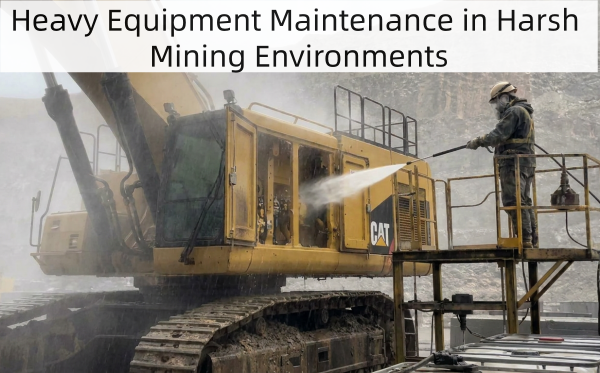
Field Wash Bay Operation in Harsh Mining Environments
THE COST OF DELAY: Uncleaned carbonized grease acts as a thermal insulator, driving up hydraulic temperatures and leading to unexpected component failure. In remote mining sites, unscheduled machine downtime can cost between $5,000 to $20,000 per hour.
For maintenance engineers, washing these heavy assemblies presents a double challenge: extreme oil build-up and extremely poor site water quality.
Most field wash bays rely on local underground or untreated borehole water. In regions like the South Gobi or Central Asian steppes, this water often exceeds 1,500 to 2,000 ppm in mineral hardness (Ca2+/Mg2+ ions).
When standard water-based degreasers mix with high-hardness water:
Formula Breakdown: Chelating systems collapse, causing active surfactants to precipitate out.
Nozzle Clogging: Precipitated white sludge blocks high-pressure spray cannons (8–12 bar).
Grease Re-deposition: Emulsified oils separate rapidly, leaving a tacky film back on cleaned carbon steel parts.
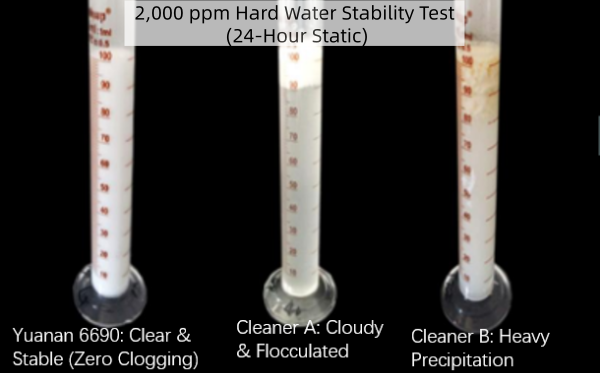
Overcoming 2000 ppm Hard Water: The Model 6690 Solution
As demonstrated in our laboratory stability test above, when mixed with 2,000 ppm calcium and magnesium hard water:
Conventional Degreasers (Middle & Right): Rapidly turn cloudy and form dense white precipitates as active surfactants react with mineral ions. In field wash bays, this white sludge causes severe scale build-up and frequent high-pressure spray nozzle clogging.
Model 6690 (Left): Remains completely clear, stable, and homogeneous over 24 hours. Its organic chelating system seals hard water minerals, ensuring 100% spray nozzle uptime and consistent cleaning efficiency.
To overcome these site-specific constraints, modern industrial degreasers—such as Heavy-Duty Water-Based Degreaser 6690—utilize advanced organic chelating stabilizers paired with low-foaming non-ionic surfactants.
Zero-Precipitation Hard Water Tolerance: Unlike conventional cleaners that fail above 500 ppm, 6690 maintains a completely homogeneous solution in up to 2,000 ppm calcium/magnesium water for 24+ hours without separation.
Ultra-Low Foaming for High-Pressure Spraying: High-pressure washing (8–12 bar) is essential for mechanical grease stripping. With a Ross-Miles foam height controlled at ≤ 4 mm (50°C), maintenance teams can operate closed-loop spray systems without pump cavitation or foam overflow.
Operating Temperature Versatility: Functions at 50–60°C for 15–30 min deep washing at 1:10 dilution, or under cold field conditions (5–10°C) at 10% concentration for 40–50 mins.
To translate technical capabilities into site efficiency, field technicians follow a simple 3-step washing protocol that eliminates time-consuming mechanical disassembly:
Step 1 (Apply): Spray 6690 working solution (1:10 dilution) directly onto heavy oil mud under 8–12 bar spray pressure.
Step 2 (Dwell): Allow 15–20 minutes for active chelating and surfactant agents to penetrate and emulsify the baked grease.
Step 3 (Rinse): Rinse down with a high-pressure water cannon to reveal bare metallic surfaces.
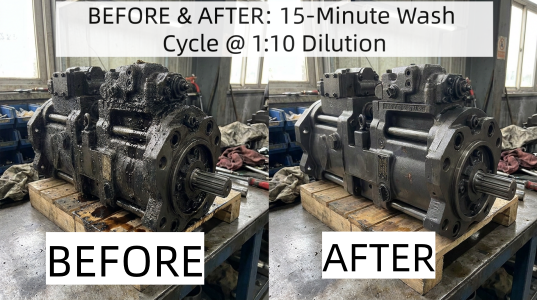
Stripping 5mm Carbonized Grease in a 15-Minute Wash Cycle
Recently, a major mining equipment maintenance contractor in Mongolia faced an urgent operational bottleneck. Solidified grease build-up on hydraulic pump housing was threatening scheduled machine overhauls, while local water hardness caused their existing degreaser to curdle in spray tanks.
Challenge: Clogged spray nozzles & ineffective degreasing in 1,800 ppm water.
Solution: Deployed 1 Ton of Concentrated Degreaser 6690 via overland freight.
Result: 100% nozzle uptime, 1:10 dilution stripped 5mm thick hardened grease in a single 15-minute high-pressure wash cycle without equipment disassembly.
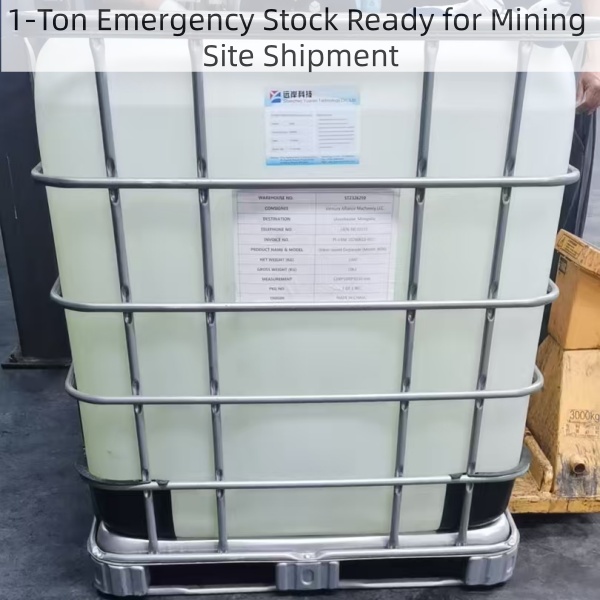
Factory Inventory Ready for Emergency Mine Site Dispatch
Adopting a high-performance degreaser delivers tangible benefits across all mine management departments:
Reduced Chemical Spend: Concentrated 1:10 to 1:33 dilution lowers per-liter active washing costs by over 40% compared to raw solvent degreasers.
Eliminated Nozzle Downtime: 2,000 ppm stability prevents calcium scale buildup, eliminating frequent spray nozzle replacement costs.
Reduced Freight Surcharges: Non-hazardous classification eliminates Class 3 hazardous cargo surcharges, saving 20%–30% on overland CIS freight.
Mining EHS officers strictly monitor wash-bay effluent. Because Degreaser 6690 contains no organic coupling solvents, emulsified oils un-bond rapidly when resting in settling pits. Operators can run a standard mechanical oil skimmer to remove the top oil layer, allowing the underlying water to meet standard industrial discharge or recirculation guidelines without expensive chemical wastewater treatment.
Because Degreaser 6690 has a closed-cup flash point > 90°C and zero volatile organic solvents, it ships as ordinary chemical freight via road or rail. Fully compliant with RoHS environmental standards, it clears international customs smoothly without hazardous cargo surcharges or prolonged documentation holds.
Q1: How should mining sites handle wash-bay wastewater after using Degreaser 6690?
A: Degreaser 6690 contains no volatile organic coupling solvents. Emulsified oils will float to the surface after standing. Mine operators can easily use a standard oil skimmer to remove the floating oil layer, allowing the underlying water to meet standard industrial discharge or recirculation guidelines.
Q2: Can Degreaser 6690 be injected directly into the internal hydraulic oil reservoir to flush sludge?
A: NO. Strictly prohibited. Model 6690 is an external surface degreaser engineered to strip baked-on grease sludge from the outer housings of hydraulic pumps, engine bays, and braided hoses. Never introduce water-based cleaners into the internal sealed hydraulic oil circuit, as detached internal sludge can clog precision valve spools. For internal oil contamination, complete pump disassembly and system flushing with dedicated hydraulic oil filters are required.
Q3: Is Model 6690 safe for washed machine paint or operator skin?
A: At recommended working dilutions (1:10 to 1:33), the fluid has a mild pH (≤10.5 @ 60°C) and contains organic corrosion inhibitors, making it safe for machinery paint and steel components. However, operators should wear standard alkali-resistant gloves and goggles when handling the raw concentrate.
Q4: Can 6690 be used in sub-zero winter temperatures?
A: The raw concentrate should be stored between 0–35°C. For winter operations (5–10°C), simply warm the concentrate drum in a shelter, stir before diluting, and extend the wash time to 30–50 minutes using 8–12 bar high-pressure spraying.
Heavy equipment maintenance in harsh environments doesn't require expensive solvent cleaners or frequent nozzle replacements. By choosing a water-based formula engineered specifically for high-hardness water and high-pressure spraying, mine operators can reduce single-use chemical costs by up to 30% while remaining EHS compliant.

