


WhatsApp:
+86-18123969340
+86-13691824013

Views: 0 Author: Site Editor Publish Time: 2026-08-04 Origin: Site


Stricter VOC regulations, ESG initiatives, and worker safety mandates are driving manufacturers away from traditional solvent-based degreasers. The industry is rapidly shifting toward safer, environmentally friendly alternatives. However, this transition introduces core operational challenges. Unlike solvent degreasing, which dissolves soils purely through chemical action, a water-based industrial cleaner relies on a delicate balance. It requires precise combinations of heat, time, mechanical agitation, and tailored chemistry to achieve identical results. Getting this balance wrong can bottleneck production lines or damage components. We wrote this guide to solve that exact problem. Our goal is to provide manufacturing and procurement engineers a pragmatic, evidence-based framework. You will learn how to evaluate and shortlist aqueous cleaning chemistry effectively. We cover substrate matching, equipment alignment, and contaminant profiles. This ensures you can switch chemistries without compromising throughput or risking substrate damage.
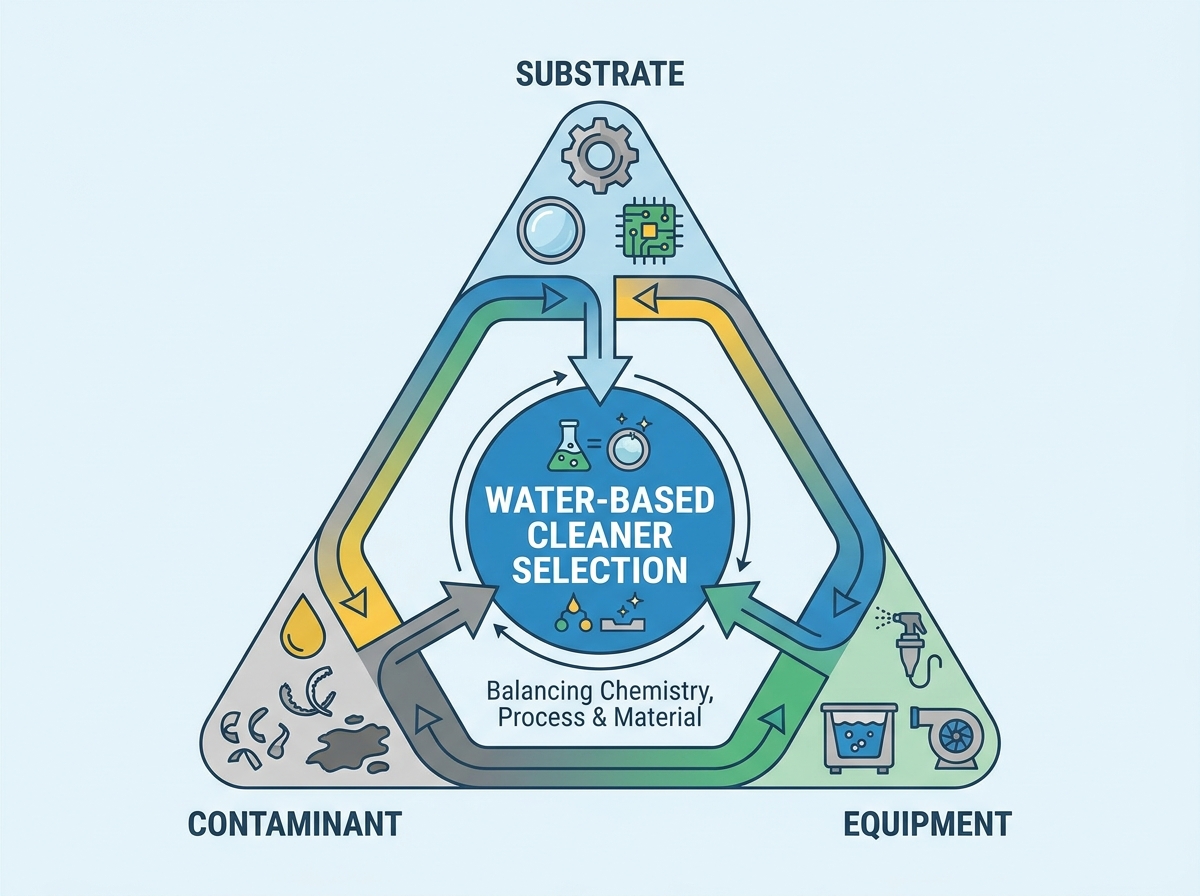
Substrate defines the chemistry: Alkaline formulas excel on heavy steel but will etch aluminum; neutral pH is mandatory for glass and delicate alloys.
Contaminant dictates the mechanism: Emulsifiers suspend heavy greases, while specific surfactants target particulate release.
Equipment limits the options: Spray-wash cabinets require low-foaming formulas; ultrasonic baths require chemistries that support cavitation.
Before you test any new chemistry, you must define what "clean" actually means for your specific operation. Moving beyond subjective visual inspections is critical. You need quantifiable metrics to ensure your new industrial cleaning agent performs consistently.
First, establish verifiable cleanliness standards. Many facilities use dyne pen testing to measure surface tension. This confirms the removal of microscopic oil films. Others rely on water break tests. A pristine surface allows water to sheet off uniformly. If water beads up, residual oils remain. High-tech applications often require microscopic particle counts to verify absolute cleanliness.
Next, audit your current operational baselines. Document your existing cycle times accurately. Record your acceptable defect rates. Measure your daily throughput volume. A successful aqueous transition must match or exceed these historical metrics. You cannot sacrifice production speed for environmental compliance.
Finally, identify all downstream processes. Consider what happens immediately after the wash cycle. Parts slated for painting, electroplating, or cleanroom packaging demand flawless surfaces. These subsequent steps have zero tolerance for surfactant residue. Remaining chemicals will cause poor paint adhesion or plating blisters.
Best Practice: Always test downstream adhesion before finalizing a chemical switch. Paint peeling often reveals poor rinsing rather than poor cleaning.
Substrate metallurgy heavily dictates your chemical selection. Ferrous metals like steel and iron tolerate highly alkaline pH levels. These robust formulas easily strip heavy carbon deposits and baked-on grease. However, they carry a major implementation risk. Steel is highly susceptible to flash rusting once cleaned. You must ensure the formula contains built-in, temporary rust inhibitors to protect parts during staging.
Conversely, non-ferrous metals demand gentler treatment. Aluminum, brass, and copper are highly vulnerable to galvanic corrosion. High alkalinity will etch aluminum surfaces rapidly. It will also cause severe staining on brass. For these sensitive metals, you require inhibited alkaline or strictly neutral pH formulas.
Common Mistake: Using a high-pH steel cleaner on mixed-metal assemblies. This inevitably destroys the aluminum components while cleaning the steel.
Substrate Compatibility and Risk Factors
| Substrate Type | Recommended Chemistry | Primary Risk | Operational Best Practice |
|---|---|---|---|
| Ferrous (Steel, Iron) | High Alkaline (pH 11+) | Flash rusting post-rinse | Use integrated rust inhibitors |
| Non-Ferrous (Aluminum) | Neutral or Inhibited Alkaline | Surface etching, dulling | Monitor bath pH strictly |
| Yellow Metals (Brass, Copper) | Neutral pH | Tarnishing, galvanic corrosion | Limit elevated temperature exposure |
Glass substrates present unique challenges. You must prioritize low-residue, free-rinsing formulas. Any leftover chemicals will cause streaking or severe optical distortion. This is unacceptable for lenses, mirrors, or display panels.
You also need to address your rinse water quality. Standard tap water contains minerals. These minerals leave spots on glass surfaces upon evaporation. Deionized (DI) or Reverse Osmosis (RO) water compatibility is mandatory for the rinse phase. Your chosen chemistry must rinse away completely in DI water without redepositing soils.
Semiconductor manufacturing and precision engineering operate under extreme constraints. When evaluating cleaners for precision parts and semiconductor, you must acknowledge strict trace-metal limits. Facility protocols demand absolute cleanroom compatibility.
You must highlight the need for neutral pH, high-purity water-based cleaners. These specialized solutions prevent the degradation of sensitive polymers. They protect intricate printed circuit boards (PCBs) from delamination. They also keep micro-mechanical assemblies functioning perfectly. Any harsh chemical can destroy trace wire bonds or etch silicon wafers.
You cannot select a chemical without understanding the soil you need to remove. Contaminants generally fall into two broad categories.
Identify whether your primary contaminant is organic or inorganic. Organic soils include cutting fluids, stamping oils, and heavy greases. Inorganic soils encompass scale, surface rust, and metallic fines. Aqueous solutions excel at removing organic oils through physical separation. Inorganic soils often require specific acidic compounds or strong mechanical force.
Once you identify the soil, choose between emulsifying and rejecting formulas.
Emulsifying Formulas: These chemicals trap oils within the solution itself. They encapsulate the grease. This approach works well for light soils or low-volume runs. However, emulsifiers eventually saturate. You will require frequent bath changes once the solution reaches maximum capacity.
Rejecting (Splitting) Formulas: These solutions separate oils and push them to the surface. You can then use mechanical skimmers to remove the floating oil. This significantly extends bath life in high-volume industrial setups.
Surface-active agents, or surfactants, drive this entire process. Surfactants reduce water's natural surface tension. Water naturally beads up. Surfactants force it to lay flat and spread. This allows the liquid to penetrate micro-crevices in complex geometries. Once inside the crevices, surfactants surround the soils and lift them away from the substrate.
Your existing machinery heavily dictates your chemical options. A formula might clean perfectly in a beaker but fail catastrophically in a machine.
Spray cabinets and conveyor washers apply fluid under high pressure. They must utilize powerful anti-foaming agents. High-pressure spray combined with the wrong surfactant creates massive aeration. This leads to excessive foam-outs. The foam will spill onto the factory floor. Worse, foam causes cavitation in the pumps, leading to immediate mechanical failure.
Ultrasonic cleaning tanks require a completely different approach. These tanks use high-frequency sound waves to create microscopic vacuum bubbles. The implosion of these bubbles scrubs the parts. Your chemistry must effectively transmit these ultrasonic waves. It cannot dampen the cavitation effect. Furthermore, the fluid requires degassing capabilities to remove trapped air before operation.
Finally, evaluate the drying reality. Water has a much higher latent heat of vaporization than solvents. It takes significantly more energy and time to dry aqueous solutions. Evaluate your facility’s capacity for forced air systems. Consider vacuum drying ovens for complex geometries. Heated blow-offs are often necessary to prevent moisture retention in blind holes. Trapped moisture will cause immediate corrosion.
Never transition a production line based purely on vendor brochures. You must validate the chemistry through rigorous real-world trials.
First, test the bath loading capacity and titration. Do not rely entirely on vendor longevity claims. Plan to test bath titration protocols daily during your trial. You need to determine the exact depletion rate of the active ingredients. This data dictates your optimal recharge frequency. It prevents you from running a depleted bath and producing dirty parts.
Second, focus on rinse step optimization. Water-based systems usually require a dedicated, overflowing rinse stage. Test the rinse bath for residual surfactant drag-out. If the rinse water becomes cloudy quickly, you are dragging too much chemical out of the wash tank. You may need air knives between stages to minimize this drag-out.
Third, establish a strict compatibility testing protocol. Always run coupon testing first. Process sample parts under exact production parameters. Match the expected temperature and dwell time precisely. Inspect the coupons under magnification. Look for micro-etching, discoloration, or localized oxidation. You must verify substrate safety before scaling to full production runs.
Evaluating your return on investment requires looking at true operational metrics. The purchase price of a chemical drum tells only a fraction of the story.
Compare the cost per part rather than the cost per gallon. Factor in the required dilution ratio strictly. Concentrate mixtures vary wildly. A more expensive concentrate might dilute at 5% and last for weeks. This is vastly cheaper in practice than a bargain cleaner requiring a 15% dilution and weekly dumps. Measure your chemical consumption against actual production yields.
Next, calculate your energy and utility costs. Aqueous solutions rely heavily on thermal energy. Calculate the electricity or gas required to maintain bath temperatures continuously. Most industrial formulas operate optimally between 120°F and 160°F. Do not forget to include the ongoing cost of DI water generation for your rinse tanks. Heating water and purifying it represent significant utility expenditures.
Finally, prioritize regulatory and industry compliance. Verify your chosen chemistry aligns with local VOC limits. Agencies like SCAQMD enforce strict air quality rules. Ensure full REACH compliance if you export products to Europe. Furthermore, secure specific industry approvals before implementation. Aerospace parts may require Boeing or Mil-Spec approvals. Food processing environments demand FDA-compliant or NSF-registered formulas. A chemical failure in compliance can shut down your entire facility.
The manufacturing industry has permanently moved away from a "one-size-fits-all solvent" mindset. Modern production requires an engineered matrix combining chemistry, equipment, and substrate. You must match the pH to the metal, pair the surfactant with the soil, and align the foaming characteristics with your machinery. Aqueous solutions deliver exceptional results when balanced correctly.
Next Steps:
Advise your procurement teams to shortlist two or three specialized vendors.
Request and review the chemical Safety Data Sheets (SDS) for all environmental compliance checks.
Mandate vendor-led sample processing using your actual soiled parts.
Run internal coupon tests to verify substrate safety before authorizing any full-scale line conversion.
A: You must use highly alkaline formulas formulated with built-in, temporary rust inhibitors. These additives leave a microscopic protective film on the steel. Additionally, employ rapid, heated drying techniques immediately after the rinse phase to eliminate moisture before oxidation begins.
A: Yes, they can safely replace toxic solvents. However, aqueous cleaning requires mechanical agitation to match solvent speed. You must add ultrasonic cavitation or high-pressure spray to the process. You also need to manage the resulting wastewater streams properly.
A: Most industrial formulas require heat to activate surfactants and melt heavy greases. The typical operating range falls between 120°F and 160°F. Some modern, highly engineered neutral cleaners can operate at room temperature for light soils, but heat generally accelerates cycle times.
A: While the cleaner itself might be biodegradable, the removed industrial soils are not. Heavy metals, cutting fluids, and greases render the spent bath hazardous. You must use skimming, ultrafiltration, or professional hauling services to manage and dispose of the contaminated fluid legally.


