


WhatsApp:
+86-18123969340
+86-13691824013

Views: 0 Author: Site Editor Publish Time: 2026-08-24 Origin: Site


Removing viscous, heavy stamping or cutting oils creates a classic industrial dilemma. You need aggressive cleaning power to lift stubborn fluids from fabricated parts. However, non-ferrous metals like aluminum, copper, and brass remain highly sensitive to harsh chemicals. They easily suffer from chemical etching, rapid oxidation, and galvanic corrosion during the wash cycle.
Getting this process wrong carries severe operational risks. You might face entire rejected batches due to sudden surface darkening. Downstream processes often fail entirely when compromised adhesion ruins your plating or coating efforts. This ultimately leads to ballooning scrap rates and disrupted production schedules.
Today, we will explore the specialized chemical formulations you need to succeed. We balance high solvency demands alongside strict substrate protection. You will learn how to evaluate, test, and select the right degreasing solutions for your facility.
Standard high-alkaline degreasers will etch and tarnish aluminum and copper; pH control and specialized inhibitors are non-negotiable.
An effective anti-tarnish degreaser separates heavy oil without leaving a microscopic barrier that could hinder post-process finishing.
Modern water-based industrial cleaners for non-ferrous metals offer equivalent solvency to legacy petrochemicals but require stricter temperature and bath-life management.
Proper evaluation requires controlled "coupon testing" to measure both oil removal efficacy and long-term surface stability.
Non-ferrous metals react poorly to standard industrial cleaners. Aluminum possesses an amphoteric nature. This means it degrades rapidly in both highly acidic and highly alkaline environments. Standard heavy-duty degreasers usually rely on caustic soda to dissolve thick greases. While this works beautifully on steel, it immediately attacks the aluminum substrate. Copper and brass present similar vulnerabilities. They tarnish instantly upon contact with reactive amines or high-pH solutions.
Improper chemistry causes severe visual and structural degradation. When alkaline chemicals etch aluminum, they leave behind a chalky white oxidation layer. Sometimes, they cause microscopic pitting across the entire surface. Copper behaves differently under chemical stress. It develops a thick black or brown oxide layer. These surface changes ruin the cosmetic appearance of the metal. More importantly, they alter the dimensional tolerances of precision-machined components.
These failures generate massive business impacts. Reworking etched parts consumes valuable labor hours. You must mechanically abrade or chemically strip the tarnished layers. In sectors like aerospace or medical manufacturing, standards strictly forbid such rework. Etched parts automatically become scrap. Furthermore, leftover chemical residues cause premature failure in downstream coatings. Paint delaminates, and electroplating flakes off.
Common Mistakes in Cleaning Non-Ferrous Metals:
Mixing steel and aluminum parts in the same highly alkaline wash bath.
Leaving parts submerged longer than recommended to compensate for weak chemistry.
Using outdated formulas containing harsh silicates which leave white powdery residues.
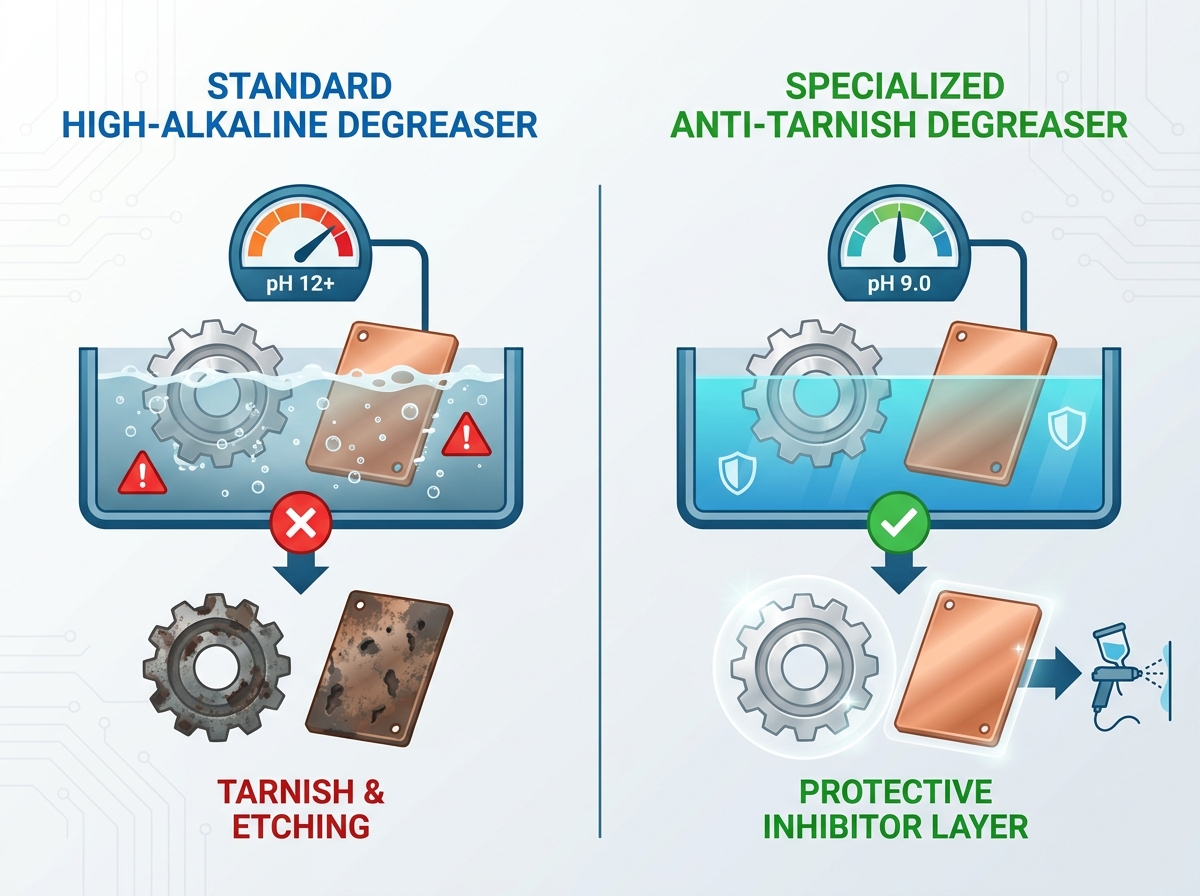
You must establish a safe pH operational window for your wash line. The ideal range for non-ferrous metals stays mildly alkaline, typically between pH 8 and 10.5. This specific window provides enough alkalinity to assist in soil removal. However, it stays below the threshold where aluminum begins to dissolve. Maintaining this balance prevents aluminum etching and stops copper from darkening.
Advanced surfactant technology replaces the need for brute-force caustic soda. Modern surfactants lower the surface tension of the cleaning solution. They penetrate under the heavy oil layer and lift it away from the metal. These engineered molecules tackle hydrocarbon, synthetic, and semi-synthetic fluids effectively. A quality anti-tarnish degreaser relies heavily on this surfactant action rather than relying on high alkalinity.
Protection during the wash cycle requires specific chemical barriers. You need water-based corrosion inhibitors integrated into the formula. Silicates act as traditional passivators. They temporarily bond to the metal surface to prevent oxidation during the wash. Non-silicated passivators offer a more modern approach. They provide the same protection but rinse away much easier. They prevent flash rusting immediately after the wash cycle completes.
Rinseability determines the success of your downstream operations. You must achieve a completely residue-free finish. If chemical inhibitors remain on the surface, they act as a microscopic barrier. This contamination leads directly to weld porosity. It also causes paint delamination and ruins plating adhesion.
Metal Compatibility and pH Thresholds
| Metal Type | Safe pH Range | Reaction to High Alkalinity (pH 11+) | Primary Protection Mechanism |
|---|---|---|---|
| Aluminum | 8.0 - 10.5 | Severe etching, pitting, white oxidation | Silicated or non-silicated passivators |
| Copper | 7.0 - 10.0 | Blackening, surface darkening | Azole-based inhibitors |
| Brass | 7.0 - 10.0 | Dezincification, color shifting | Mild pH control, specific surfactants |
| Steel (For comparison) | 10.0 - 14.0 | No reaction; aids in rust prevention | High alkalinity acts as a rust inhibitor |
Legacy solvents dominated industrial cleaning for decades. Chemicals like trichloroethylene (TCE) and n-propyl bromide (nPB) offer incredible cleaning power. They dissolve heavy stamping oils instantly without causing oxidation. However, their drawbacks now outweigh their benefits. Facility managers face tightening VOC regulations globally. Furthermore, flammability, worker toxicity, and escalating disposal costs make these solvents unsustainable for modern manufacturing.
Aqueous solutions represent the scalable, compliant standard today. Modern water-based industrial cleaners for non-ferrous metals utilize a different mechanism to clean. Because they lack harsh chemical solvents, they rely on heat and mechanical agitation. You must introduce ultrasonic waves or high-pressure spray to compensate. The combination of heat, engineered surfactants, and physical force effectively shears heavy oil away from delicate substrates.
Oil separation capabilities dictate the lifespan of your wash bath. You should prioritize demulsifying formulas over emulsifying ones. Emulsifying cleaners trap the oil within the water. This quickly saturates the bath and degrades cleaning performance. Demulsifying formulas reject the oil. They force heavy oils to float to the surface of the wash tank. This mechanism allows you to use simple oil skimmers to remove the contamination continuously.
Best Practices for Bath Maintenance:
Install a coalescing oil skimmer on the primary wash tank.
Run the skimmer during off-shift hours when the bath water remains still.
Monitor the bath concentration weekly using a simple titration kit or refractometer.
Temperature management requires strict oversight. Water-based formulas usually demand heat, typically running between 120°F and 150°F. This heat activates the surfactants and lowers the viscosity of heavy oils. However, this introduces a major process risk. If you expose hot non-ferrous parts to ambient air before rinsing, the water evaporates instantly. This flash-drying leaves concentrated chemical residues on the surface, causing instant spotting and oxidation.
You must match your chemistry to your specific equipment. The mechanical agitation method dictates the type of formula you need. Ultrasonic immersion tanks require chemistry with excellent cavitation properties. More importantly, immersion tanks need low-foaming surfactants. Conversely, high-pressure spray cabinets introduce massive amounts of air into the fluid. Spray applications require specifically formulated defoamers to prevent the tank from overflowing with suds.
Rinsing and drying protocols are just as critical as the wash itself. You cannot rely on standard municipal tap water for the final rinse. Tap water contains chlorides, calcium, and magnesium. These minerals bake onto hot aluminum parts, creating permanent water spots. You must implement DI (deionized) or RO (reverse osmosis) water rinses. Follow this immediately with forced-air drying. Rapid drying prevents flash corrosion and ensures a pristine surface.
You must begin your selection process with substrate compatibility testing. Industry professionals call this coupon testing. You take sample parts, or standard metal coupons, and expose them to the proposed chemistry. You test them at the exact temperature and concentration you plan to run. After the wash, monitor the parts for 24 to 48 hours. You must verify zero tarnish, zero white rust, and zero blackening over this critical window.
Next, perform accurate soil identification. You cannot select an anti-tarnish degreaser for non-ferrous metals without understanding the contaminant. Straight sulfurized cutting oils behave very differently than paraffinic stamping fluids. Sulfurized oils require specific emulsifiers to break their bond to copper. Heavy waxy draw compounds often require slightly higher temperatures to melt the wax before the surfactants can lift it.
Finally, conduct a thorough facility and environmental compliance check. A cleaner might perform flawlessly in the lab but fail your local regulations. Verify your municipal wastewater discharge limits regarding heavy metals and hydrocarbons. Check local VOC restrictions. If you manufacture parts for specific sectors, ensure the chemistry meets necessary standards. Look for RoHS compliance, REACH registration, or specific aerospace approvals before introducing the chemical to your floor.
Protecting aluminum, copper, and brass requires a deliberate operational shift. You must move away from brute-force caustic cleaning methods. Instead, you need to implement engineered, inhibited chemistry designed specifically for sensitive substrates. Balancing pH levels, utilizing advanced surfactants, and managing wash temperatures ensures your parts emerge clean and bright.
Begin by requesting a comprehensive chemical audit of your current wash line. Obtain safety data sheets (SDS) for all proposed new cleaners to verify their pH levels and inhibitor packages. Finally, initiate small-batch pilot testing using representative metal coupons. This testing phase validates performance before you integrate the new chemistry into full-scale production.
A: Generally, no. Heavy-duty steel degreasers are often highly alkaline (pH 12+) and will quickly etch aluminum. You must use a multi-metal safe formula with specific aluminum inhibitors if you are mixing substrates in the same wash line.
A: Blackening is typically copper oxide or copper sulfide formation. This happens when reactive amines, high pH levels, or leftover sulfur and chlorine from cutting fluids interact with the wrong chemical cleaner during the heated wash cycle.
A: It depends entirely on the formula. Silicated inhibitors can leave a microscopic film. This protects against tarnish but may interfere with certain high-tech coatings. Non-silicated, residue-free options exist specifically for plating-prep applications.
A: While the cleaner itself may be environmentally friendly, the heavy oil it removes is hazardous. You should skim the separated oil for separate disposal. Always consult local wastewater regulations regarding heavy metal and hydrocarbon discharge limits before dumping the bath.


