


WhatsApp:
+86-18123969340
+86-13691824013

Views: 0 Author: Site Editor Publish Time: 2026-08-31 Origin: Site


Semiconductor and photovoltaic (PV) manufacturing face escalating margin pressures today. As node sizes shrink and wafer thicknesses decrease continuously, contamination tolerances rapidly approach zero. Legacy solvent-based cleaning methods create compounding issues across modern production lines. Operators deal with high VOC emissions constantly. They face increasingly expensive disposal protocols. These outdated methods also cause severe integration bottlenecks in high-throughput wet benches.
We see a vital operational pivot toward engineered aqueous chemistries driving the industry forward. This shift transforms fab environments globally. Evaluating a high-purity aqueous formulation is no longer just a simple compliance upgrade. It stands as a critical yield-protection strategy. Advanced solutions safeguard complex semiconductor structures from irreversible damage. In this article, you will discover the fundamental mechanisms behind advanced aqueous cleaning. We will explore stage-specific formulations like targeted pre-cleaners. Finally, we will guide you through selecting the right chemical partner to ensure scalable, consistent manufacturing performance.
Yield First: Transitioning to aqueous cleaning requires balancing aggressive particle removal with strict substrate preservation—avoiding micro-roughness or oxidation.
Process Specificity: Effective wet cleaning is not a one-size-fits-all solution; it demands stage-specific formulations (e.g., dedicated alkaline pre-cleaners for DWS solar wafers to handle slurry and silicon dust).
Validation Over Claims: Procurement and engineering teams must evaluate chemical suppliers based on lot-to-lot consistency, bath life stability, and proven QC/QA validation frameworks, rather than theoretical laboratory efficacy alone.
Yield dictates profitability directly in modern wafer fabrication. Every processing step must perform flawlessly. Post-CMP (Chemical Mechanical Planarization) and wire-sawing residues leave severe defects on fragile substrates. CMP planarizes the wafer perfectly but leaves behind a dense slurry of nano-particles. These microscopic defects increase scrap rates rapidly. They drive your defect density up. Higher defect density directly reduces overall facility revenue.
Contaminants fall into three main categories demanding specific removal strategies. First, we examine particulates and slurry. Diamond Wire Sawn (DWS) silicon dust and abrasive residues cling tightly to wafer surfaces. They require intense mechanical and chemical energy for complete removal. Second, we face organic contaminants. Cutting fluids, machine coolants, and human handling residues create stubborn hydrophobic layers. These layers block subsequent etching or coating steps. Third, we deal with inorganics and trace metals. Ionic contamination degrades electrical performance drastically. Even trace amounts cause severe leakage currents in finished semiconductor devices.
Facilities now face strict Environmental, Social, and Governance (ESG) mandates. Regulatory bodies increasingly scrutinize chemical disposal volumes globally. Safety regulations force fab managers to phase out aggressive solvents entirely. We see a massive shift toward water-based alternatives to meet these stringent requirements. Environmental compliance demands lower toxicity and reduced chemical exposure limits. Aqueous solutions deliver safer handling procedures for cleanroom staff. They also provide significantly easier effluent management for the plant overall.
Generic industrial degreasers cannot meet strict fab requirements. They often leave hidden micro-residues behind. These residues ruin subsequent deposition steps entirely. You need a dedicated water-based semiconductor cleaner to guarantee pristine, defect-free surfaces.
How do these advanced chemistries actually work? The secret lies in precise chemical mechanisms targeting specific intermolecular forces.
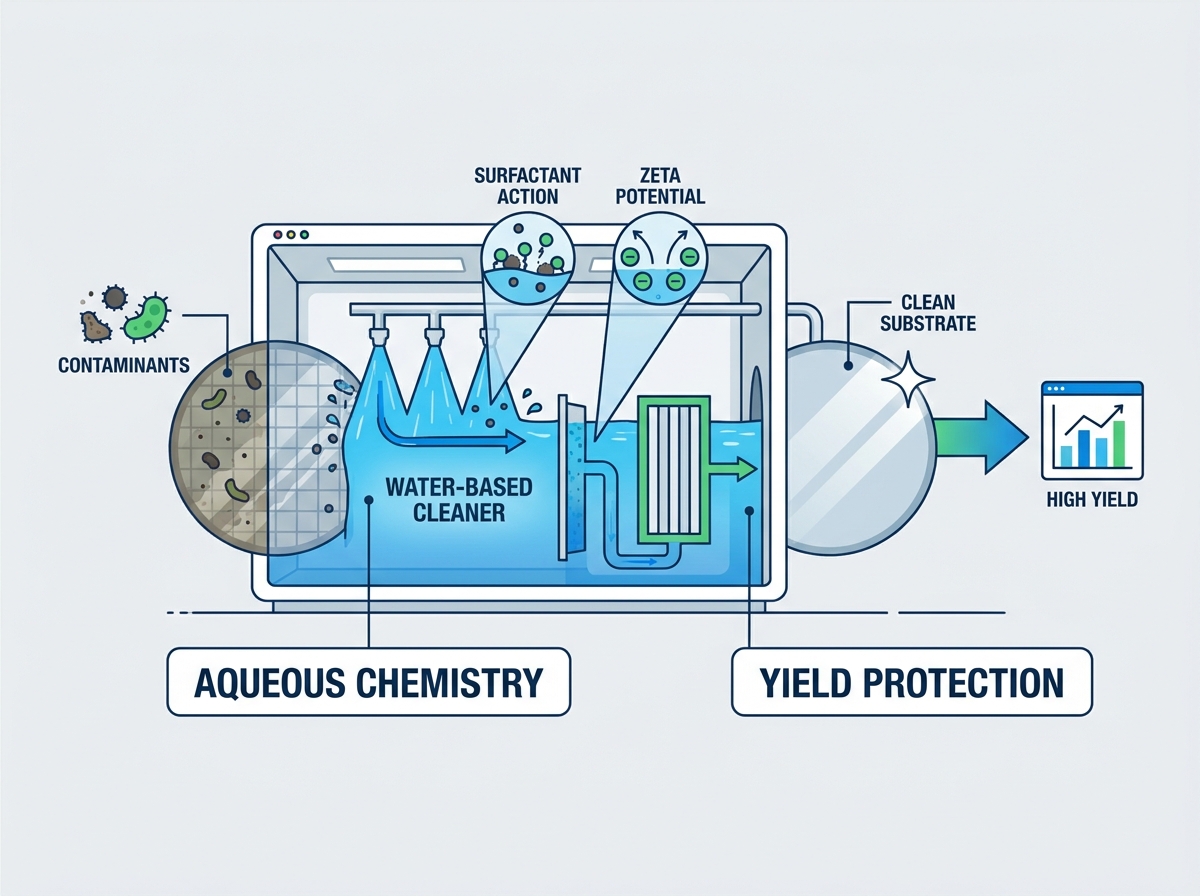
Surfactants play a vital role in the cleaning process. They lower the dynamic surface tension of the fluid significantly. This allows the cleaner to penetrate deep micro-trenches seamlessly. It reaches hidden areas where mechanical agitation cannot go. The cleaner lifts contaminants away gently without leaving chemical residues behind. It transforms stubborn hydrophobic spots into highly wettable hydrophilic zones.
Next, we look at zeta potential manipulation. Particles often re-adhere to the wafer due to electrostatic attraction. Effective cleaners alter these electrostatic charges on both the wafer and the removed particle. They shift the zeta potential to create a strong repulsive force. This prevents removed particles from re-depositing onto the delicate wafer surface during the critical rinse cycle.
Purity remains completely non-negotiable in this industry. Evaluating these chemicals requires strict measurement limits. You must ensure trace metal levels stay within parts-per-trillion (ppt) ranges. The formulation must entirely lack mobile ions like sodium and potassium. These specific ions cause catastrophic device failures by drifting through the gate oxide layers.
Best Practice: Always request independent lab verification of ppt metal levels before introducing a new cleaner to your main bath.
Common Mistake: Do not substitute high-purity formulas with lower-grade alternatives to stretch budgets. The resulting yield loss will quickly outweigh any minor chemical savings upfront.
Photovoltaic manufacturing presents unique, aggressive challenges. Both monocrystalline and multicrystalline silicon wafers undergo intense slicing processes. Diamond Wire Sawn (DWS) wafers carry heavy organic coolant loads directly from the saw. They also collect massive amounts of fine silicon powder during the cutting phase. This combination creates a dense, stubborn sludge adhering tightly to the silicon surface.
Removing this sludge requires targeted, heavy-duty chemical action. An engineered alkaline pre-cleaner for DWS solar wafers provides the exact solution needed. Pre-cleaning directly dictates your downstream texturing uniformity. If organics remain, the subsequent texturing acids will not etch the silicon evenly. This creates visual defects and lowers overall cell conversion efficiency.
These specialized cleaners rely on a chemical process called alkaline saponification. The active chemistry converts insoluble organic cutting fluids into water-soluble soaps. This transformation facilitates rapid, high-volume rinse off in automated modules. It clears the wafer surface efficiently, prepping it for subsequent texturing steps perfectly.
However, alkaline exposure always brings inherent risks. The primary danger involves unintended anisotropic etching. Aggressive bases can naturally etch the silicon along specific crystal planes. They might degrade the wafer's physical geometry unintentionally. This causes severe micro-roughness or alters the wafer thickness unevenly.
Advanced formulations solve this exact problem beautifully. They carefully buffer the pH level using proprietary additives. This precise buffering allows the cleaner to remove embedded particles aggressively. At the same time, it perfectly preserves the original substrate geometry. You get a thoroughly clean wafer without suffering any structural damage.
Production environments demand highly scalable chemical solutions. We must evaluate these water-based industrial cleaners for precision manufacturing across several critical performance dimensions. Operational scalability hinges on chemical endurance.
Let us look at a features-to-outcomes matrix. This framework helps process engineers assess real-world viability effectively before full deployment.
First, consider bath life extension. High chemical stability under continuous recirculation prevents premature fluid degradation. The chemistry resists breaking down even under elevated temperatures. A longer active bath life significantly reduces equipment downtime. It ensures steady, predictable production rhythms for high-volume manufacturing lines.
Second, rinsability matters immensely to your throughput. You must remove the cleaner completely using Deionized (DI) water after the wash step. Specialized formulations lower molecular adhesion to the substrate. Fast rinsability directly increases your Wafers Per Hour (WPH) metric. It clears the wet bench faster for the next batch and minimizes drag-out contamination.
Third, equipment compatibility is vital for long-term operations. The chemistry must not degrade fluoropolymer components. Automated wet stations rely heavily on specific advanced plastics. Safe formulations protect these expensive machine parts perfectly. They prevent stress cracking and material embrittlement over time.
Protected components typically include:
PTFE fluid delivery manifolds controlling flow rates.
PFA tubing and high-purity chemical transfer lines.
Quartz tanks and associated sensor housings.
O-ring seals and specialized pump diaphragms.
Cleaner Performance Evaluation Matrix
| Feature | Chemical Mechanism | Manufacturing Outcome |
|---|---|---|
| Bath Life Stability | Resists breakdown under heat and recirculation | Minimizes downtime and fluid replacement cycles |
| High Rinsability | Low molecular adhesion to silicon substrates | Accelerates DI water rinsing and boosts throughput |
| Polymer Compatibility | Non-reactive toward PTFE/PFA plastics | Protects wet bench hardware and piping |
Implementing new chemistry requires careful, structured validation. We must transparently acknowledge one major fact. Laboratory cleaning results rarely scale perfectly to full-fab production without adjustments. Beaker tests lack the dynamic fluid flow of a real wet bench. You must tune the process parameters directly on the production floor to achieve optimal results.
We recommend a strict, data-driven verification approach. Use standard QC metrics to measure actual success accurately. Relying on simple visual inspections simply will not suffice for modern sub-micron geometries.
Key verification steps include:
Utilizing advanced surface particle counters to ensure defect density drops below target thresholds reliably.
Monitoring Total Organic Carbon (TOC) levels strictly in the final rinse water to verify complete organic removal.
Deploying Atomic Force Microscopy (AFM) to guarantee the chemistry introduced absolutely no surface roughness.
Waste treatment integration represents another critical reality. Effluent processing poses major logistical challenges for large facilities today. The chosen chemistry must flow safely into your existing industrial wastewater treatment plant (AWN systems). It absolutely cannot cause unexpected foaming issues in the facility drains. Furthermore, it must avoid triggering dangerous chemical precipitation when mixed with other fab effluents. Such precipitation clogs treatment filters and violates municipal heavy metal discharge limits.
Best Practice: Always conduct a small-volume effluent compatibility test. Mix the new cleaner with existing waste streams in a controlled lab setting before full factory deployment.
Finding the right chemical formulation is only half the battle. You must carefully evaluate the supplier producing the chemicals for semiconductors. A great formula means absolutely nothing if the manufacturer cannot deliver it consistently.
Lot-to-lot consistency stands out as a primary evaluation factor. Chemical manufacturers must provide strict Certificate of Analysis (CoA) documentation with every batch. We expect them to share detailed statistical process control (SPC) data openly. This transparency proves they control their manufacturing environment tightly. It guarantees the assay levels remain identical month after month, preventing random yield drops.
Supply chain security deserves equal attention during procurement. Evaluate their raw material sourcing redundancy carefully. A single-source point of failure at the chemical plant can cause massive fab stoppages. Reliable partners maintain multiple sourcing avenues for their critical raw materials. They conduct extensive shelf-life studies. They insulate you from global shipping disruptions and raw material shortages.
What should you do next? Start by requesting a comprehensive technical consultation with their engineering team. Review the safety data sheets (SDS) thoroughly with your EHS department. Finally, set up a controlled bench-scale trial to validate the chemistry against your specific stubborn contaminants.
Optimizing your wet cleaning protocols remains a highly powerful strategy. Deploying the correct aqueous chemistry improves both product yield and facility compliance simultaneously.
Successful integrations always rely on verifiable data. They depend on consistent manufacturing practices from your chemical supplier. They require seamless wet-bench compatibility to keep throughput high.
Here are your immediate actionable next steps:
Audit your current solvent usage to identify high-risk compliance areas immediately.
Define your exact maximum tolerance for trace metal contamination across all processing nodes.
Map out your existing wastewater treatment constraints to prevent effluent bottlenecks.
Request sample chemistries for an initial bench-scale qualification trial today.
Schedule a deep technical evaluation of your existing cleaning process soon. Protect your yields and streamline your fab operations effectively.
A: RCA cleaning relies on harsh mixtures of hydrogen peroxide, ammonia, and acids. Engineered aqueous cleaners replace these with advanced surfactants and precise chelating agents. They achieve comparable particulate and metal removal. However, they operate at lower thermal budgets and significantly reduce hazard profiles for facility staff.
A: Bath life fluctuates based on daily wafer throughput and overall organic loading. Fortunately, engineered solutions utilize robust stabilizing buffers. These specific buffers maintain active cleaning efficacy up to 30% to 50% longer than basic commodity hydroxides. This extends the replacement cycle notably.
A: No. High-quality precision cleaners feature specific "free-rinsing" formulations. They break molecular bonds cleanly without adhering to the substrate. Because they wash away so easily, they often require less ultra-pure water to achieve your baseline resistivity targets compared to poorly formulated generic alternatives.


