


WhatsApp:
+86-18123969340
+86-13691824013

Views: 0 Author: Site Editor Publish Time: 2026-08-11 Origin: Site


Upgrading industrial parts cleaning processes often forces a difficult choice. Facility leaders must maintain steady production throughput while meeting stricter Environmental, Health, and Safety (EHS) mandates. Managers and process engineers actively seek safer options. They want reliable alternatives to highly regulated legacy solvents like TCE or nPB. Yet, they fear sudden process bottlenecks. They worry about flash rusting on ferrous metals. They also dread incomplete soil removal on complex component geometries. Making the wrong choice disrupts entire manufacturing lines. Making the right choice ensures long-term compliance and steady operations. This guide provides an objective, evidence-based breakdown of aqueous, solvent, and semi-aqueous formulas. We outline how to evaluate material compatibility effectively. You will understand cycle time impacts before initiating a line change. Read on to discover which chemical mechanism aligns best against your specific soils, substrates, and operational constraints.
Water-based cleaners offer the highest safety and regulatory compliance but require mechanical energy (heat, agitation) and dedicated drying systems.
Solvent cleaners excel at rapid, residue-free drying and heavy organic soil removal but carry higher risks regarding flammability, toxicity, and VOC regulations.
Semi-aqueous cleaning agents bridge the gap, dissolving heavy tars and waxes like a solvent, but allowing for a water rinse, though they complicate waste separation.
Never switch chemistries without a physical pilot test; spec sheets cannot account for your specific substrate-soil-equipment interactions.
Legacy cleaning lines relied heavily on aggressive solvency. They utilized fast-evaporating halogenated solvents to strip oils instantly. This historical baseline sets a high operational standard for speed. Operators expect dry, residue-free parts immediately after the wash cycle ends. Vapor degreasers accomplished this task perfectly for decades. However, regulatory bodies continue to intervene globally.
Phase-outs of specific volatile organic compounds (VOCs) act as the primary catalyst for evaluation. Stricter OSHA and EPA enforcement pushes facilities toward safer fluid alternatives. You can no longer rely on hazardous trichloroethylene (TCE) or n-propyl bromide (nPB). Regulators target these chemicals due to severe toxicity and ozone depletion risks. Manufacturers face intense pressure to adapt quickly.
A viable replacement must match your current cleanliness specification perfectly. You might measure operational success via dyne level surface tension testing. You might use strict gravimetric analysis to weigh microscopic particulate residue. The new chemistry must achieve these exacting standards reliably. It must do so without drastically increasing processing cycle times. It should not demand a massive equipment footprint either. Balancing this trade-off requires understanding exact chemical mechanisms. You must analyze how each fluid interacts mechanically and chemically against target contaminants.
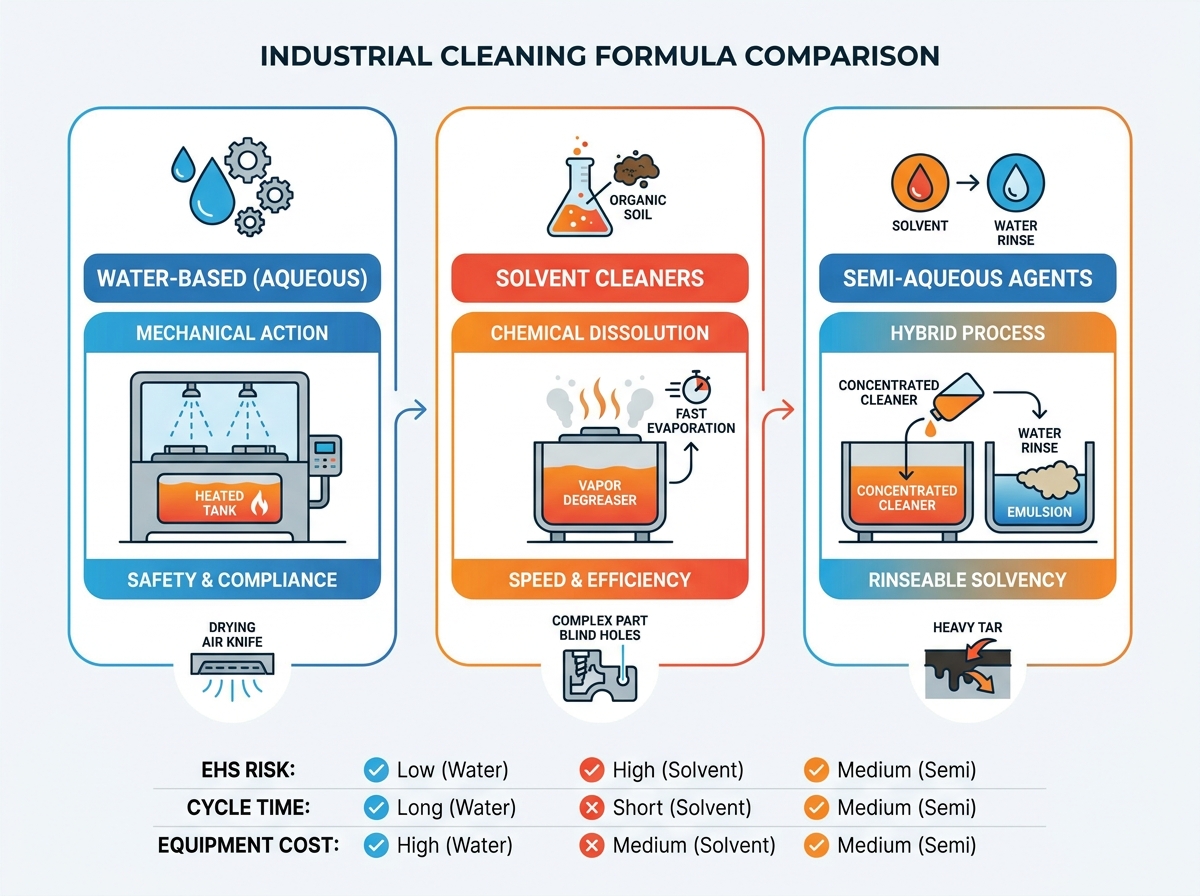
Aqueous fluids, solvent systems, and hybrid agents operate under entirely different physical principles. We must focus strictly on chemical mechanics rather than generic marketing labels. Understanding these mechanisms ensures you select the correct tool.
Mechanism: This technology relies on a precise combination of water, surfactants, and alkaline builders. It requires added heat and mechanical action. You typically supply this action through ultrasonic cavitation or high-pressure spray jets. Unlike strong chemical solvents, water-based cleaners lift and emulsify soils. They do not strictly dissolve the contaminants. The surfactants reduce surface tension significantly. This allows the fluid matrix to penetrate beneath the soil layer. The mechanical agitation then scrubs the contaminant away from the substrate.
Optimal for: These formulas excel at removing stubborn particulates. They clean inorganic soils like machining salts and synthetic coolants effectively. They handle light-to-medium oils exceptionally well. Manufacturers prefer them for high-volume continuous processes. You see them heavily utilized in automotive and aerospace manufacturing lines.
Mechanism: Chemical affinity drives this entire process. The solvent naturally dissolves organic soils upon contact. It operates entirely on the fundamental "like dissolves like" chemical principle. Solvent cleaners require absolutely no water. They rarely need high heat to function efficiently. The liquid penetrates the contaminant directly. It breaks the molecular bonds of the grease instantly. Evaporation then leaves the part completely dry.
Optimal for: They tackle heavy stamping greases and thick solder fluxes easily. They penetrate intricate blind holes effectively. Water often gets trapped inside these tight capillary spaces. They remain the absolute standard for moisture-sensitive metals. Complex electronic assemblies and medical implants rely heavily on these fast-drying properties.
Mechanism: These unique hybrids combine naturally derived or synthetic solvents. Common ingredients include citrus terpenes or modified alcohols. Manufacturers blend these solvents alongside robust surfactants. You apply the concentrated semi-aqueous cleaning agent directly onto the soiled part. The solvent phase attacks the heavy organic soils aggressively. After a brief dwell time, you rinse the part using clean water. The surfactants allow the solvent and the trapped soil to wash away together.
Optimal for: This option targets heavy crude oils and baked-on resins. It tackles complex polishing waxes efficiently. You choose this technology when pure aqueous solutions fail completely. You also deploy it when pure solvents pose unacceptable workplace exposure hazards. It bridges the performance gap reliably.
How do you match the right chemistry to your specific production line? You must evaluate your soil types, substrate vulnerabilities, and facility safety mandates closely. A mismatch leads to ruined parts or dangerous working conditions.
Polarity dictates cleaning success fundamentally. You must always match the cleaner to the target soil type. Use water-based industrial cleaning agents for removing coolants and polar soils. Use solvent formulas for heavy, non-polar hydrocarbons. Mixing polarities guarantees poor performance and high residue left behind.
Substrate risks complicate the selection process further. Aqueous fluids pose severe flash rusting risks on ferrous metals. You must include specialized rust inhibitors to prevent rapid oxidation. These amines protect the metal during the vulnerable drying phase. Conversely, strong solvents threaten plastics and elastomers constantly. They can cause rapid swelling. They often cause severe structural degradation in O-rings or polymer seals. You must verify compatibility for every material present on your assembly.
Aqueous systems present a fundamentally non-flammable, low-VOC profile. They offer excellent overall worker safety. They rarely trigger strict air quality reporting requirements. Facility leaders appreciate this minimal regulatory burden.
Solvent systems introduce distinct combustible or flammable risks. They carry strict permissible exposure limits (PEL) established by health organizations. Facility managers must ensure proper ventilation. They must monitor vapor concentrations continuously around the equipment. Workers often require personal protective equipment (PPE) during maintenance. Hybrid agents reduce total vapor emissions significantly. However, they still introduce organic compounds into the facility atmosphere.
Different chemistries demand different long-term management strategies. Solvents evaporate continuously. They require sealed equipment designs to contain vapors. They demand specialized chiller coils to condense the fluid back into a liquid state.
Water-based systems behave differently. They require energy-intensive heating elements to maintain optimal bath temperatures. They demand constant chemistry monitoring. You must measure concentration, pH levels, and soil loading daily. You must replenish evaporated water and depleted surfactants regularly. Scaling an aqueous process requires planning for high energy consumption during the extensive drying phases.
Cleaning Technology Compatibility Summary
| Technology Type | Primary Mechanism | Target Soil Polarity | Drying Speed | Safety Profile |
|---|---|---|---|---|
| Aqueous | Emulsification & Lift | Polar (Salts, Coolants) | Slow (Requires Forced Air/Heat) | High (Low VOC, Non-Flammable) |
| Solvent | Chemical Dissolution | Non-Polar (Grease, Oil) | Very Fast (Evaporates naturally) | Low/Moderate (Combustible, High VOC) |
| Hybrid | Dissolution & Rinse | Mixed (Resins, Waxes) | Moderate (Requires Water Rinse) | Moderate (Reduced VOCs) |
A poorly planned chemical switch causes catastrophic production bottlenecks. Transitioning away from legacy degreasers introduces entirely new operational challenges. You cannot simply swap fluids inside existing machinery.
Switching to aqueous chemistries demands significant hardware modifications. You cannot pour water-based fluids into an old vapor degreaser. You must add dedicated rinsing stages. Rinsing removes the detergent residue left behind by the wash bath. You also need intensive drying systems. Installing heated air knives or vacuum dryers prevents downstream corrosion.
These equipment additions consume valuable manufacturing floor space. They complicate daily line maintenance. They require new plumbing and dedicated exhaust ducting. Facility managers often underestimate the sheer physical footprint required for a multi-stage aqueous washer.
Aqueous systems generally take longer per cycle. Fast-evaporating vapor degreasing solvents flash off in seconds. Parts emerge clean, dry, and ready for immediate packaging. Water requires forced evaporation.
The entire heating, washing, rinsing, and drying sequence extends processing time significantly. A process taking three minutes previously might now require fifteen minutes. Facilities must optimize batch sizes carefully. They must stage components efficiently to maintain daily throughput. You must adapt your upstream and downstream workflows to accommodate this slower pace.
Handling spent chemistry varies dramatically across the three main categories. You must plan for waste disposal before installing new equipment.
Solvent Recovery: Facilities often distill and reclaim solvents directly on-site. Equipment boils the dirty solvent. It condenses the pure vapor back into the clean tank. This closed-loop approach reduces raw waste volume massively. You only discard the concentrated heavy sludge remaining at the bottom.
Aqueous Treatment: Water-based wash tanks accumulate floating tramp oils over time. You must install oil skimmers and coalescing filters to extend bath life. Facilities potentially face complex pH neutralization steps before discharging rinse water. Municipalities strictly regulate what enters their drain systems.
Hybrid Disposal: These distinct agents create highly complex emulsions during the rinse phase. Splitting these tight oil-water-solvent mixtures proves notoriously difficult. Standard gravity separation often fails. Wastewater treatment becomes highly specialized and requires external chemical treatment programs.
Follow a structured approach to avoid unexpected production halts. Guessing leads to severe operational failures. We recommend adhering to these four distinct validation steps.
Map the Contaminant Profile: Identify exactly what needs removal. Gather your safety data sheets for all lubricants and compounds. Is it a mixed soil combining cutting oil and metal chips? Is it a pure synthetic wax? Document the exact chemical nature of every single contaminant entering the wash stage.
Define Substrate and Geometry Limits: Inspect the physical design of your components. Note all microscopic blind holes and tight capillary spaces. Identify any dissimilar metal assemblies prone to galvanic corrosion. Note any sensitive elastomers. These physical traits dictate your maximum allowable drying time and fluid compatibility.
Audit Existing Infrastructure: Determine your available factory floor footprint. Can you comfortably fit a massive multi-stage aqueous washer? Do you have sufficient electrical power for high-wattage drying heaters? Are you physically locked into a single-chamber vacuum degreaser footprint due to space constraints? Answer these questions early.
Demand Pilot Testing: Never rely solely on marketing brochures or technical spec sheets. Send your heavily soiled parts directly to a chemical manufacturer's testing laboratory. Demand strict empirical validation. Test cleaning efficacy, residue levels, and drying speed thoroughly before beginning procurement. Real-world physical testing reveals hidden problems immediately.
There is no universal "drop-in" replacement fluid available today. You must evaluate your specific production variables carefully. Aqueous options rightfully dominate modern manufacturing facilities. They provide unmatched safety profiles and excellent regulatory compliance. However, solvent and hybrid formulas remain critical tools. They handle specific high-reliability tasks perfectly. They tackle heavy-duty applications where water fails.
Your next steps require data gathering. Gather the MSDS sheets for your current factory soils. Define your internal cleanliness validation methods clearly. Establish whether you need dyne testing or visual inspection. Consult an experienced application engineer immediately. Schedule a controlled laboratory test run using your actual soiled components. Data-driven decisions guarantee a successful process transition.
A: Yes, they absolutely can if used improperly on ferrous metals. Water inherently promotes oxidation. You must select formulas containing built-in amine rust inhibitors. You also need rapid, thorough drying processes like heated air knives. Complete moisture removal prevents flash rusting effectively.
A: No. Regulatory bodies heavily restrict legacy halogens like TCE and Perc. However, manufacturers developed modern engineered solvents. Fluorinated fluids and modified alcohols remain fully compliant. Aerospace and medical facilities use these advanced solvents widely for precision applications.
A: You should avoid them when your facility lacks advanced wastewater treatment capabilities. These hybrids create complex oil, water, and solvent emulsions. Splitting this mixture requires specialized chemistry. They also fail when your part geometry makes thorough water rinsing impossible.


