


WhatsApp:
+86-18123969340
+86-13691824013

Views: 0 Author: Site Editor Publish Time: 2026-08-17 Origin: Site


Every facility manager faces a demanding operational balancing act. You need to maintain peak solar yields and flawless optical clarity across massive glass arrays. However, pushing too hard for cleanliness often risks irreversible surface degradation. Stripped anti-reflective coatings, etched facade glass, and chemically degraded silicone seals silently destroy asset value. The industry is rapidly shifting away from harsh industrial solvents and abrasive chemical mixtures toward highly calibrated precision chemistry. A neutral water-based cleaner now represents the baseline requirement for commercial-scale, risk-averse maintenance on delicate high-value surfaces. In this guide, we break down why standard cleaning methods fail. You will discover the chemical mechanics behind safe particulate removal. Finally, we provide actionable protocols for selecting and deploying the right formula to maximize your operational return on investment.
Protecting Anti-Reflective (AR) coatings and optical clarity requires strict pH neutrality to prevent micro-etching over time.
Achieving a streak-free finish depends entirely on a zero-residue formulation paired with purified (RO/DI) water.
Procurement evaluation should weigh the cost-per-liter against the long-term ROI of prolonged surface lifespan and environmental run-off compliance.
Proper application relies heavily on environmental timing (avoiding high-heat flash drying) and correct dilution protocols.
Soiling represents one of the largest controllable losses in utility-scale energy generation. Dust, pollen, and industrial smog form tough layers over photovoltaic modules. Operators typically document efficiency drops ranging between 5% and 20%. The financial impact scales dramatically. A mere 5% generation loss on a 100-megawatt solar plant equates to massive revenue deficits annually. Facade glass and optical surfaces face similar hurdles. Urban pollution creates optical distortion. This distortion reduces light transmission and harms the aesthetic integrity of high-profile commercial real estate.
To combat this, maintenance teams historically reached for aggressive chemicals. High-alkaline degreasers, ammonia-based solutions, and volatile solvents remove stubborn dirt quickly. However, they inflict devastating long-term damage. High pH levels attack the microscopic structure of glass. Over multiple cleaning cycles, alkaline chemicals strip away specialized anti-reflective (AR) coatings. They also cause localized galvanic corrosion on anodized aluminum frames. Furthermore, harsh solvents quickly degrade the silicone sealants surrounding panels. Once these seals fail, moisture penetrates the module. This leads to delamination and permanent electrical failure.
Many operators attempt to avoid chemical damage by switching entirely to "pure water" cleaning. They deploy Deionized (DI) or Reverse Osmosis (RO) water. While pure water prevents mineral scaling, it presents a significant operational flaw. Pure water completely lacks surfactant properties. It cannot break the strong chemical bonds formed by oily smog, baked-on bird droppings, or heavy industrial fallout. You end up applying higher mechanical pressure with brushes to remove the dirt. This excess friction creates micro-scratches across the glass. The pure water trap creates a false sense of security while failing to clean effectively.
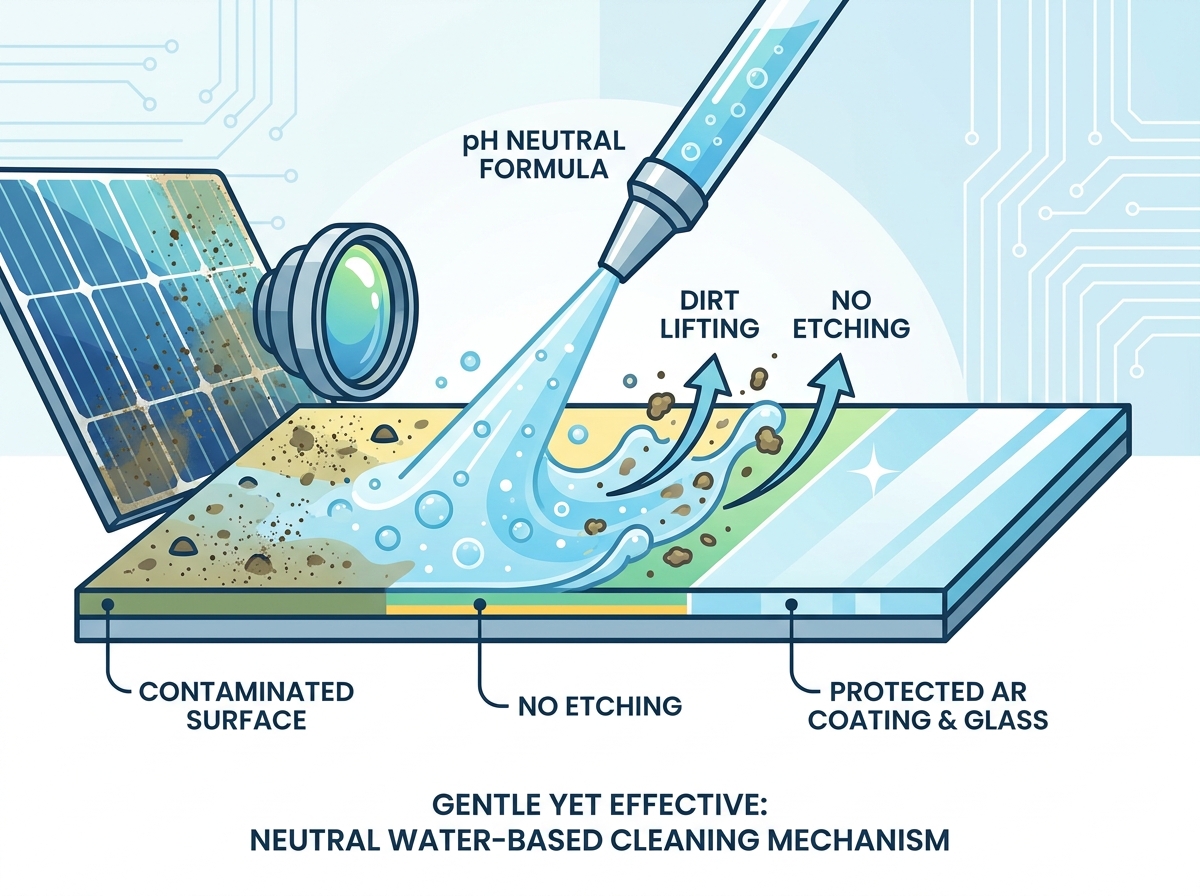
Precision chemistry solves the tension between effective cleaning and asset protection. The core mechanism relies on a perfectly balanced pH profile. We define a true neutral cleaner as maintaining a pH strictly between 6.5 and 7.5. These specialized surfactant blends do not rely on chemical burning or acidic etching to remove dirt. Instead, they alter the surface tension of the contaminant layer. The surfactants penetrate the boundary between the soil and the glass. They lift the particulate matter away from the surface gently. You wash away the dirt without chemically interacting with the delicate substrate below.
Material compatibility sets these advanced formulas apart. Commercial solar arrays and modern architectural facades feature complex material combinations. You must safely clean anodized aluminum, exposed wiring plastics, edge sealants, and sensitive optical glass simultaneously. Neutral formulas demonstrate an impeccable safety profile across all these materials. They prevent the chemical embrittlement of rubber gaskets. They ensure aluminum framing remains fully resistant to oxidation. Your operations and maintenance (O&M) teams can confidently apply these solutions without worrying about collateral asset damage.
Safety protocols also become significantly easier to manage. You eliminate the risks associated with volatile organic compounds (VOCs). When teams deploy water-based cleaners for delicate surfaces, they avoid handling flammable liquids. These formulas do not emit toxic fumes during high-temperature applications. Workers require less cumbersome personal protective equipment (PPE). Storage regulations become less stringent. By prioritizing non-volatile chemistry, facility managers streamline their safety compliance while drastically improving the cleaning results.
Selecting the right maintenance chemical requires understanding how evaporation affects the final surface state. Many standard detergents look clean when wet. However, as the water evaporates, dissolved solids remain behind. These microscopic films cause rapid re-soiling. Dust particles naturally adhere to soapy residues. In a laboratory context, zero-residue means the solution leaves absolutely no measurable dissolved solids upon evaporation. In the field, it means the glass dries perfectly clear. It offers no sticky anchor points for future airborne particulates.
Procurement teams must demand specific technical metrics when qualifying a new product. You need to verify the total dissolved solids (TDS) contribution of the formula. A true zero-residue solar panel cleaner will rinse away completely when flushed with purified water. It prevents the rapid accumulation of dirt, keeping panels operating at peak efficiency for longer durations between washes.
Environmental compliance acts as another strict filter during evaluation. Commercial cleaning operations generate thousands of gallons of runoff. This wastewater often drains directly into agricultural soil or urban groundwater systems. A compliant formula must be fully biodegradable. It must contain zero heavy metals, zero phosphates, and no PFAS (per- and polyfluoroalkyl substances). Phosphates trigger harmful algae blooms in local water sources. Regulatory bodies impose steep fines on facilities violating runoff standards. You must ensure your chosen chemistry meets all local environmental codes.
Always verify industry-standard testing and certifications. High-quality manufacturers subject their products to rigorous third-party evaluations. Look for compatibility certifications from recognized bodies like TÜV Rheinland. Ensure the product holds OEM (Original Equipment Manufacturer) approvals from major solar panel brands. These certifications prove the chemical will not void your hardware warranties.
Chemical Profile Comparison
| Feature | Alkaline Degreasers | Pure Water (RO/DI) | Neutral Precision Chemistry |
|---|---|---|---|
| pH Level | 9.0 - 12.0 | 6.5 - 7.0 | 6.5 - 7.5 |
| AR Coating Safety | Low (High risk of stripping) | High | High |
| Oily Soil Removal | Excellent | Poor | Excellent |
| Residue Risk | High (Leaves alkaline salts) | Zero | Zero (when correctly formulated) |
Not all dirt behaves the same way. Loose, dry agricultural dust washes away easily with minimal effort. However, environmental conditions often create complex, stubborn soiling profiles. Facilities near construction sites or cement plants face cementitious dust. This dust hardens when exposed to morning dew. Spring seasons bring sticky pollen layers. Urban environments deposit baked-on smog and exhaust oils. Each of these contaminants requires targeted chemical action.
Standard surfactants struggle against dense, microscopic matter. Integrating a high-efficiency fine particle cleaning agent solves this challenge. Advanced formulations penetrate the microscopic gaps between the glass and the hardened soil. They encapsulate micron-level dust particles. By surrounding each particle, the chemical prevents the dirt from dragging across the glass. You can rinse the encapsulated dirt away seamlessly. This mechanism prevents the micro-scratching typically caused by friction during the washing process.
Quality formulations also feature superior suspension properties. Once you lift the dirt from the surface, it must stay in the water column. Inferior soaps allow dirt to settle back onto the glass before the rinse phase finishes. We refer to this as redeposition. High-quality suspension agents hold the contaminants firmly within the liquid foam or water stream. When the squeegee passes or the final rinse occurs, the dirt flows off the panel entirely. This ensures a flawless, highly transmissive surface.
Even the most advanced chemical formulations fail if implemented incorrectly. The most crucial operational assumption involves your water source. If you dilute a premium cleaner with hard tap water, you will inevitably leave mineral spots. Calcium and magnesium in municipal water streams dry into hard white circles on the glass. These spots block sunlight and defeat the purpose of cleaning. You must pair professional chemistry with Reverse Osmosis (RO) or Deionized (DI) water. This combination guarantees a pristine finish.
Temperature constraints dictate your operational schedule. Glass surfaces on commercial buildings or solar arrays reach extreme temperatures during midday sun. Applying cool water to a hot panel causes thermal shock. This can shatter the glass instantly. Furthermore, high heat causes flash-drying. If the cleaning solution evaporates before you can rinse it, it leaves the suspended dirt baked back onto the surface. You must mandate application timing strictly.
Follow these operational timing rules:
Begin cleaning operations just before dawn or during the early morning hours when panels are cool.
Resume cleaning during late evening hours as solar irradiance drops.
Target fully overcast days to maximize operational hours.
Always test glass temperature before applying liquid solutions.
Your chosen solution must integrate smoothly with your existing technology stack. Modern maintenance relies on various application modalities. Teams use water-fed carbon fiber poles, tractor-mounted boom sprayers, and automated robotic cleaners. The chemistry must accommodate all of them. Foaming presents a major variable. High-pressure sprayers agitate chemicals. If a formula produces heavy foam, it will blind the navigation sensors on automated cleaning robots. High-foaming agents also demand excessive rinse water. A low-foaming, highly dilutable formula ensures compatibility with mechanical automation while conserving vital water resources.
Procurement teams often face conflicting claims from chemical vendors. The most effective way to validate a product involves localized pilot testing. Never deploy a new chemical across an entire gigawatt-scale facility blindly. Establish a controlled A/B test instead.
Select one string of solar inverters or one specific facade section. Clean the test area with the new neutral formula. Clean the adjacent control area using your legacy method. Monitor the results over a 30-day period. For solar assets, pull the SCADA data to track exact efficiency differences. Check for rapid re-soiling rates after the first rain event. This hard data bypasses marketing claims.
When calculating the financial justification, you must shift your perspective. Do not evaluate chemical solutions purely on the "Cost per Gallon" or "Cost per Liter." Cheap chemicals cost you far more in long-term damage and lost energy. Instead, measure the true return on investment (ROI). For solar applications, calculate the "Cost per Megawatt Recovered." For architectural facades, calculate the "Labor Hours Saved" due to faster rinsing and extended time between washes. Precision chemistry always wins these structural metrics.
Vet your suppliers thoroughly before finalizing contracts. Use this checklist during vendor evaluations:
Documentation Transparency: Ensure immediate availability of Safety Data Sheets (SDS) and Technical Data Sheets (TDS).
Dilution Clarity: Verify exact dilution ratios required for different contamination levels.
Supply Chain Scalability: Confirm the vendor can deliver bulk quantities consistently for multi-megawatt farms.
Warranty Compliance: Request formal documentation proving OEM panel compatibility.
Maintaining high-value optical surfaces and photovoltaic assets requires a disciplined approach to chemistry. Substituting specialized formulations with cheap, harsh alternatives represents a dangerous false economy. Alkaline degreasers and volatile solvents slowly degrade your high-CAPEX assets, stripping away coatings and destroying weather seals. Meanwhile, relying solely on pure water leaves heavy smog and organic oils completely untouched. Precision neutral chemistry solves this exact gap.
By utilizing balanced, pH-neutral solutions, you protect delicate surface materials while achieving maximum contaminant removal. You ensure rapid rinsing, zero residue, and compliance with stringent environmental runoff standards. The upfront investment in high-quality chemistry pays dividends through prolonged asset lifespans, increased energy yields, and drastically reduced labor hours.
Take proactive steps to upgrade your maintenance protocols today. Contact your chemical manufacturer to request a detailed Technical Data Sheet (TDS) and Safety Data Sheet (SDS). Procure a commercial evaluation sample and initiate a 30-day A/B pilot test on your facility. Let the data drive your transition to safer, more effective surface management.
A: No. Standard soaps contain additives, fragrances, and salts that leave a sticky residue, accelerating dust accumulation and potentially voiding panel warranties.
A: Depends on site conditions (agricultural vs. industrial). Typically 1-3 times a year for solar; frequency is dictated by real-time efficiency monitoring drops of >5%.
A: Generally, no. Neutral cleaners are designed for preventative maintenance and organic/particulate removal. Existing mineral etching requires specialized, carefully managed acidic remediation, which carries higher asset risks.
A: Yes, provided the formula is low-foaming. High-foaming agents can blind robot sensors or require excessive rinse water, defeating the efficiency of automation.


