


WhatsApp:
+86-18123969340
+86-13691824013


Views: 0 Author: Site Editor Publish Time: 2026-10-12 Origin: Site


Many composite manufacturers fall into a dangerous procurement trap. They evaluate chemical suppliers purely by the price tag on the drum. This upfront volume pricing rarely reflects the actual operational yield. The real problem lies in hidden manufacturing inefficiencies. Cheap chemicals often require frequent reapplication and cause unexpected scrap. Over time, these hidden expenses drastically inflate your production overhead. You need an objective, evidence-based formula. This guide provides process engineers and purchasing managers with a clear calculation method. We will focus on determining the true cost of an agent based on viable, defect-free parts. Accurately measuring these metrics during a qualification trial is the only way to validate vendor claims. By the end of this guide, you will know exactly how to project long-term ROI. You will stop buying cheap gallons and start buying successful parts.
Volume Pricing is Misleading: A lower cost per gallon often masks higher application frequencies and increased scrap rates, inflating the true cost per part.
Hidden Costs Drive Total Expenditure: Tool cleaning downtime, labor for reapplication, and part rework/scrap significantly outweigh the raw chemical cost.
The "Accepted Part" Metric: The most reliable baseline for evaluating chemical efficiency is dividing total process costs by the number of defect-free parts produced in a specific production run.
Data-Driven Trials: Structuring a controlled trial is essential to isolate variables and capture accurate consumption and cycle-time data.
We must rethink how we buy chemicals. Comparing the upfront invoice price fails completely. It ignores manufacturing realities on your shop floor. You might save money on a cheap drum. However, your production line pays a heavy penalty later. The cost-per-gallon fallacy blinds purchasing departments to daily operational drains. They see savings on paper. Meanwhile, operators struggle to keep production moving.
Transfer efficiency varies wildly between formulations. Active ingredients form the actual barrier. Carrier solvents simply deliver those ingredients. Cheap liquids often use heavy carrier solvents. They look highly affordable per gallon initially. Yet, they leave behind very few active ingredients. The solvent just evaporates into the air. Higher solids might cost more upfront. You need significantly less volume per application though. They build a robust barrier quickly and efficiently. You use ounces instead of gallons.
Application frequency heavily influences your bottom line. Slip helps a part separate easily. Durability dictates your overall production speed. A premium composite mold release agent offers exceptional durability. It might allow for multiple pulls per application. You spray the tool once. Then, you pull five or six clean parts. Cheaper alternatives usually lack this chemical durability. They force operators to spray the mold after every single cycle. This constant reapplication wastes expensive labor. It halts production unnecessarily. It introduces a massive hidden bottleneck into your daily schedule.
Ignoring the active solid content percentage entirely.
Focusing strictly on purchasing budgets instead of manufacturing yields.
Failing to consult shop floor operators about daily application struggles.
Buying bulk drums before running a small-scale validation trial.
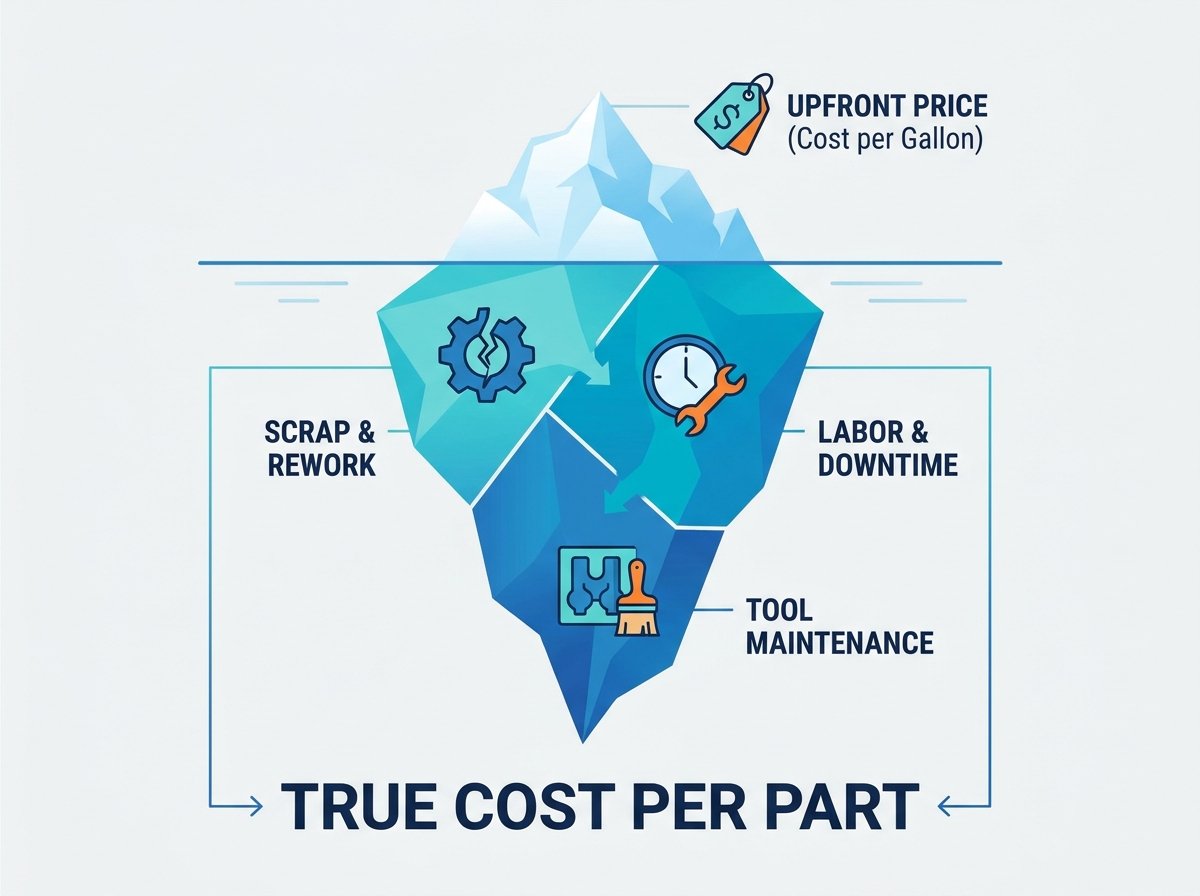
Stop guessing about chemical expenses. The basic calculation relies on a straightforward formula. It reveals your genuine manufacturing expenditure. You must move beyond rough estimates. Process engineering requires hard data.
Here is the foundational calculation framework. You divide your total process expenses by your successful output. The formula is: (Total Cost of Release Agent Used + Total Associated Labor/Downtime + Total Scrap/Rework Cost) / Number of Accepted Parts. This equation isolates the precise financial burden. It assigns every hidden cost directly to a viable part. It eliminates all budgetary blind spots.
Chemical consumption tracking requires strict precision. You cannot guess usage based on visual spray times. Fluid dynamics distort those visual estimates. Nozzle wear changes spray volumes daily. Outline strict methods for measuring actual usage carefully. The best practice involves weighing the physical spray equipment. Weigh the canister before a shift begins. Weigh it again after the shift ends. This yields the exact mass of chemical consumed. It removes all operator guesswork completely.
Labor and cycle time represent massive financial leaks. You must quantify the time variable accurately. Calculate the hourly wage of the operator applying the agent. Also, calculate the specific machine rate during application time. When a mold sits idle, it generates zero revenue. Faster application minimizes this expensive downtime. Slow wipe-on processes drain your profitability. Every minute spent buffing steals a minute of active curing time. We must account for these lost minutes in the final formula.
Use a calibrated digital scale for all chemical weighing tasks.
Log operator application time separately from general mold preparation time.
Record machine downtime specifically caused by chemical reapplication.
Train operators to use consistent spray patterns during evaluation periods.
Scrap remains the most expensive variable in composite manufacturing. A single scrapped part wastes expensive resin. It ruins technical reinforcement fabrics. It throws away hours of operator labor. It also burns valuable machine time. We must track these failures relentlessly.
Poor release performance causes very specific defects. Pre-release occurs early in the curing cycle. The part separates prematurely from the tool. This ruins dimensional stability completely. Fish-eyes and dulling ruin the cosmetic finish. They force workers to sand and polish the surface later. Parts sticking in the mold represent the worst-case scenario. Operators pry them out forcefully. They often damage both the part and the expensive tool.
Material-specific sensitivities demand strict attention. Evaluating an epoxy resin release agent requires looking closely at exothermic reactions. Epoxies get extremely hot during curing. They present severe chemical bonding risks. The release barrier can fail under high heat. If this happens, the epoxy bonds directly to the tool. This rapidly degrades the tool surface. It forces massive repair expenses. You cannot afford barrier failure during a high-heat exotherm.
Calculating scrap impact requires a structured framework. Add the cost of raw materials for each scrapped part. Include the lost labor hours spent building it. Assign this combined penalty to the overall chemical cost burden. This creates a realistic view of vendor performance.
Scrap Cost Assignment Framework
| Defect Type | Primary Cause | Material Wasted | Labor Impact (Hours) |
|---|---|---|---|
| Pre-release Distortion | Excessive slip formulation | Full resin and fiber | 1.5 to 3.0 |
| Fish-eyes / Dulling | Uneven chemical transfer | Surface gel coat | 0.5 to 1.5 (Rework) |
| Sticking / Bonding | Barrier heat failure | Full part plus tool damage | 5.0+ (Extraction & Repair) |
| Resin Build-up | Low formulation durability | None directly | 2.0 (Heavy cleaning) |
Mold build-up dictates your production rhythm. Heavy chemical transfer fouls the mold surface rapidly. Styrene and resin build-up also occur over time. These stubborn deposits dictate your cleaning schedule. They force you to stop production entirely. A dirty mold cannot produce an accepted part.
Downtime valuation exposes major hidden expenses. When a mold goes offline, you lose valuable production hours. We must calculate the true cost of this lost time. Heavy cleaning takes entire shifts to complete. Chemical stripping and resealing require meticulous labor. Multiply your hourly machine revenue rate by these lost hours. The resulting number usually dwarfs your monthly chemical invoice. You quickly realize cheap agents cost a fortune in cleaning time.
Aggressive cleaning methods accelerate tool wear rapidly. Inferior agents force you to use harsh solvents. You might resort to frequent dry ice blasting. These abrasive methods degrade the tooling gel coat. They shorten the overall tool lifespan significantly. This adds massive replacement fees to your long-term capital costs. Protecting your mold surface saves thousands of dollars annually. A superior barrier reduces cleaning frequency dramatically. It keeps the mold in production longer.
Schedule preventive cleaning based on pull counts, not visual dirt.
Track the exact hours spent stripping molds each month.
Calculate the revenue lost during these specific maintenance windows.
Avoid abrasive blasting unless absolutely necessary for hard polymer removal.
You need objective data, not sales pitches. Structuring a controlled trial requires strict manufacturing discipline. Isolating variables provides a truly valid comparison. Run the trial on the exact same mold. Use the same operator for both chemicals. Keep the same resin system. Maintain identical shop environmental conditions. Changing any other variable ruins the trial validity.
Establishing the baseline always comes first. Run your current baseline chemical for one full week. You must capture accurate current-state data. Do this before introducing the new agent. This gives you a clear point of comparison. Do not skip this crucial benchmarking step.
Data collection protocols keep the trial objective. Operators must log specific metrics meticulously. They cannot rely on memory at the end of a shift.
Total shift duration and exact machine uptime.
Number of successful pulls per single application.
Exact scrap count and minor defect count.
Total time spent wiping or buffing the mold.
Apply strict shortlisting logic to the final results. Recommend moving forward only with superior formulations. The winner must demonstrate a verifiable reduction in final costs. The cost per accepted part is the only metric you should trust. Ignore the per-drum invoice price completely. The data will reveal the true financial winner.
Release Agent Trial Comparison Chart
| Metric Tracked | Current Baseline Chemical | New Trial Formulation | Financial Impact |
|---|---|---|---|
| Price per Gallon | $45.00 | $85.00 | Higher upfront invoice |
| Pulls per Application | 1 to 2 pulls | 5 to 7 pulls | Massive labor reduction |
| Scrap Rate | 4.5% | 1.2% | Significant material savings |
| Cleaning Frequency | Every 50 cycles | Every 150 cycles | Increased machine uptime |
| Cost per Accepted Part | $2.15 | $1.42 | 34% Cost Reduction |
Evaluating release agents requires a holistic perspective. You cannot use a narrow procurement lens. We must analyze the entire process thoroughly. You must measure exactly what happens on the shop floor.
Prioritize the "cost per accepted part" over bulk volume pricing.
Track cycle time and tool downtime accurately.
Quantify every scrapped part into the final chemical evaluation.
Run controlled, single-variable trials to prove vendor claims objectively.
Aligning purchasing decisions with production success drives higher margins. It creates far more predictable composite manufacturing outcomes. Start your next trial today. Measure your baseline accurately. Protect your tools, empower your operators, and increase your yield. Let data drive your next chemical sourcing decision.
A: Semi-permanents cost more per gallon initially. However, they usually yield a much lower cost per part in high-volume production. They allow for multiple pulls per single application. This vastly reduces labor time and prevents rapid mold build-up. Sacrificial agents require constant reapplication, which drives up hidden labor expenses and slows down production lines.
A: A valid trial should span at least one full cleaning cycle. It must start from the initial mold prep phase. It should continue to the exact point where the mold requires stripping again. This timeframe accurately captures build-up rates, transfer issues, and true maintenance downtime. A shorter trial will hide long-term fouling issues.
A: Point to hidden variables in your process. Tool surface degradation occurs over time, creating micro-scratches. Changes in shop humidity or ambient temperature heavily impact chemical curing. Slight variations in the resin formulation can also alter bonding behavior. These shifts require adjusting your specific release application technique to compensate for the new environmental reality.


